The 3 Incredible Secrets of the Physical AI Revolution in 2026
On This Page
We have reached the “Atlas Moment”—the birth of the physical AI revolution.
For the past few years, the AI boom was something you watched on a screen. You typed a prompt, and the AI replied. But as we move through January 2026, the walls between the digital and physical worlds have collapsed.
At CES 2026, Boston Dynamics and Hyundai turned heads by unveiling the first production-ready version of the electric Atlas robot. This isn’t a lab experiment anymore; it is a commercial-grade worker with a brain powered by the latest foundation models. Here is why 2026 is the year AI finally got a body.
1. From Scripted Motion to “Physical” Reasoning
In the past, robots were hard-coded. To make a robot move a box, an engineer had to write thousands of lines of code defining every joint angle. In 2026, that approach is dead.
The physical AI revolution is built on “End-to-End” learning. Thanks to a partnership with Google DeepMind, the new Atlas uses Gemini-class robotics models to “reason” through physical space. If the robot encounters an obstacle it has never seen before, it doesn’t freeze; it uses its vision-language-action model (VLA) to understand the context and find a solution, just like a human would.
2. The Power of “Motion Capture Learning”
How do you teach a robot to handle a fragile car part or fold a t-shirt? You show it. One of the biggest breakthroughs discussed at CES is the use of markerless motion capture to train these physical agents.
By watching thousands of hours of video of humans performing tasks, Atlas can “distill” those movements into its own mechanical structure. This allows a fleet of robots at a Hyundai plant to learn a complex assembly task in less than 24 hours. The AI is no longer just processing words; it is mastering the physics of our world.
3. Built for the Long Haul: Hardware Meets Intelligence
The production version of Atlas unveiled this month features several “real-world” upgrades that make the physical AI revolution sustainable:
- Autonomous Battery Swapping: When Atlas runs low on power, it doesn’t wait for a human. It navigates to a station, swaps its own battery in under three minutes, and gets back to work.
- Field-Replaceable Limbs: In a nod to industrial reliability, every limb on the Atlas can be replaced in the field in under five minutes, minimizing downtime in busy factories.
- 360-Degree Awareness: With sensors embedded in its head and hands, the robot has no “blind spots,” allowing it to work safely alongside human colleagues without the need for safety cages.
4. Why 2026 is the Turning Point
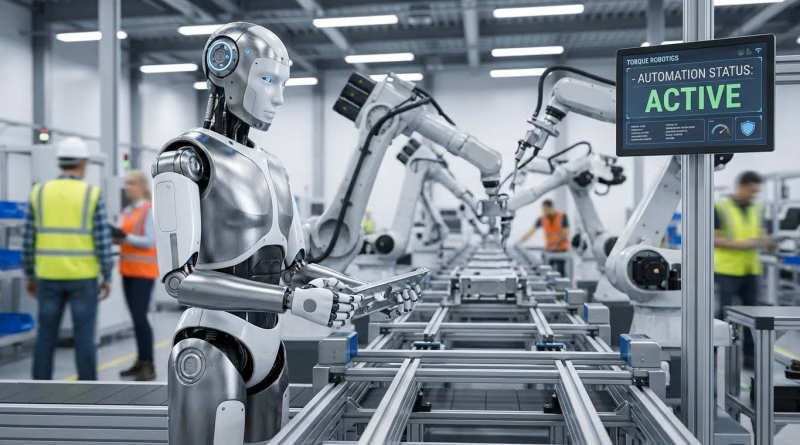
What makes this the “Atlas Moment” is scale. Boston Dynamics has announced plans to produce up to 30,000 robots per year at its new U.S. facility. We are moving from “one-off” demonstrations to “heterogeneous fleets.”
As we look toward the rest of the year, these robots will begin their first official deployments at the Hyundai Metaplant in Georgia and within Google’s data centers. They will be sequencing parts, moving heavy loads, and performing the high-risk tasks that humans shouldn’t have to do.
The Verdict: The World is the New Desktop
The physical AI revolution represents the ultimate goal of artificial intelligence: a system that can help us in the physical world. Whether it’s solving labor shortages in manufacturing or eventually assisting in our homes, the arrival of a “bodied” AI changes everything.
In 2026, the smartest person in the room might just be the one made of periwinkle-blue aluminum.