
AI Copyright Reckoning: 7 Massive Legal Battles Shaking the Tech World
On This Page
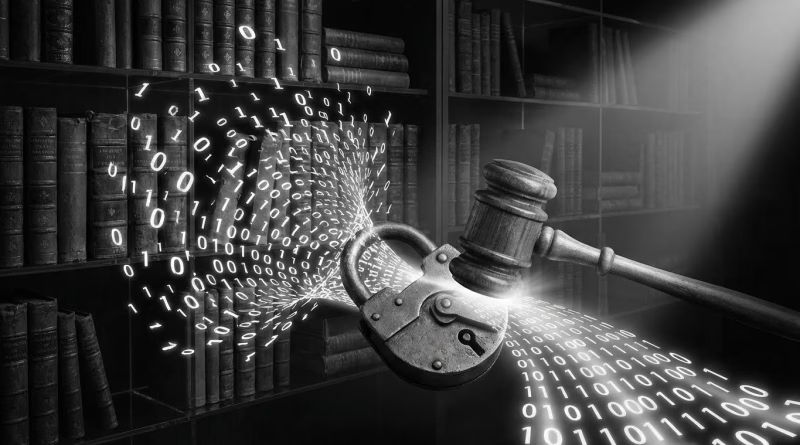
AI copyright reckoning is no longer a distant threat for tech giants; it has become a catastrophic reality that is fundamentally reshaping the economics of artificial intelligence. For years, AI developers operated under the assumption that the public web was a “free library” for training their massive models. They argued that using copyrighted data to teach a machine was a “transformative use”—a key pillar of the fair use doctrine. However, as we move through this year, the courts and creators are pushing back with massive force, demanding a new social contract that protects human intellectual property in an age of infinite machine reproduction.
The “Wild West” era of unauthorized data scraping is officially coming to a halt. Here are the pillars of the shift we are currently witnessing.
The Death of “Fair Use” as a Blanket Defense
The heart of the AI copyright reckoning is the debate over fair use. Recent pivotal court rulings have begun to draw a sharp line between “lawful” and “unlawful” training data. In several closely watched cases, judges have held that while training on lawfully acquired materials might be transformative, the use of pirated or unauthorized “shadow libraries” constitutes clear infringement.
This distinction has sent shockwaves through the industry. It means that “transformativeness” is no longer a get-out-of-jail-free card for AI companies. If the underlying data was obtained through piracy or in violation of clear “no-training” disclaimers, the fair use defense collapses. This shift is forcing developers to move toward a “Licensing First” model, where they must prove the legitimacy of every byte of data used in their training runs.
The Multi-Billion Dollar Precedent
Nothing illustrates the stakes of the AI copyright reckoning more clearly than the landmark settlements reaching the billion-dollar mark. While the headline-grabbing numbers are a shock to the industry, the “fine print” is even more consequential: developers are being required to destroy datasets containing pirated materials.
This “Data Destruction” penalty is the ultimate nightmare for AI labs. It doesn’t just cost money; it can effectively “lobotomize” a model by forcing the removal of the very data that made it intelligent. We are now seeing a “Flight to Quality” where developers are scrambling to secure long-term licensing deals with major publishers and media groups to avoid these catastrophic outcomes.
The Rise of “Poisoning” and Opt-Out Tech
As the legal battle rages in the courts, creators are taking the AI copyright reckoning into their own hands with technical counter-measures. There has been a widespread adoption of “Data Poisoning” tools, which subtly alter digital artwork so that it appears normal to humans but corrupts the training process of an AI model.
Furthermore, major platforms are now integrating “Human-Origin” verification and robust opt-out mechanisms. Leading AI video-generation tools have introduced policies that allow rights holders to request the exclusion of their intellectual property from both the training and generation phases. The burden of proof has shifted: it is no longer the creator’s job to hide; it is the developer’s job to ask.
Global Transparency and Regulatory Pressure
While some regions focus on litigation, others have moved toward aggressive legislation. New global standards now mandate strict transparency requirements for providers of generative AI. Under these rules, AI-generated content must be clearly identifiable, and developers must provide detailed documentation on the copyrighted data used to train their models.
This pressure is creating a “Gold Standard” for ethical AI. Companies that want to operate in the international market are being forced to adopt these transparency rules, effectively ending the era of the “Black Box” model. This transparency allows creators to finally see if their work has been used without permission, providing the evidence needed for further legal action.
A New Era of Permission-Based Tech
The AI copyright reckoning is not about stopping progress; it is about ensuring that progress is sustainable. By forcing a move away from “theft” and toward “licensing,” the legal system is creating a more stable foundation for the AI economy.
As we move forward, the most successful AI companies will be those that view creators as partners rather than resources. The next era of the web will belong to those who respect the “Human Spark” that makes the digital world worth browsing in the first place.