
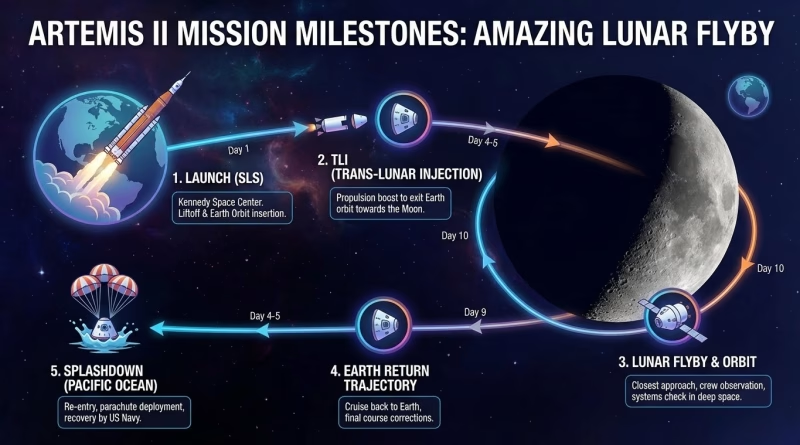
7 Explosive Artemis II Mission Milestones for an Amazing Lunar Flyby
On This Page
The cosmos beckons, and humanity is answering with unprecedented technological might. In 2026, the Artemis II Mission is poised to etch its name into history, marking the first crewed journey beyond low-Earth orbit since Apollo 17 in 1972. This isn’t merely a lunar flyby; it’s a meticulously planned series of engineering triumphs and human endurance tests, designed to validate critical systems for sustainable lunar presence. As a foundational precursor to future lunar landings, the Artemis II Mission will execute seven explosive milestones. Let’s dive deep into the data and the audacious engineering defining this amazing lunar flyby.
Trans-Lunar Injection and Orion Deep Space Validation
The journey begins with the sheer power of the Space Launch System (SLS) rocket. Its Block 1 configuration generates 8.8 million pounds (39.1 meganewtons) of thrust, making it the most powerful ever flown. The first crucial milestone is achieving stable Earth orbit, followed by a highly precise Trans-Lunar Injection (TLI) burn. This approximately 18-minute maneuver propels Orion and its crew exceeding 24,500 mph (39,400 km/h) to escape Earth’s gravity. Artemis I data showed 100% SLS core and upper stage burn success, instilling high confidence in this critical phase. Once en route, the second milestone is a comprehensive deep space checkout. The crew will activate and verify every critical system aboard Orion – life support, communications, propulsion. Data streamed back to Earth confirms Orion’s readiness for sustained human presence beyond the Van Allen belts. Engineers will specifically analyze the European Service Module (ESM), with its 33 engines, ensuring its performance throughout the entire approximately 10-day Artemis II Mission duration.
Crewed Deep Space Operations and Radiation Management
Operating in deep space presents unique challenges, particularly from radiation exposure. The third milestone involves the crew — Reid Wiseman, Victor Glover, Christina Koch, and Jeremy Hansen — demonstrating effective deep space living and working while proactively managing this risk. They’ll perform critical procedures like in-flight maintenance and collect vital biomedical data. Orion employs enhanced radiation shielding, including a “storm shelter” for solar particle events (SPEs). Data from crew dosimeters and internal sensors will continuously assess the radiation environment and shield effectiveness. This Artemis II Mission phase is crucial for future long-duration Mars missions, where cumulative doses will be significantly higher, potentially exceeding annual occupational limits 10-15 times without robust protection. The ability to mitigate these risks effectively will be a key scientific takeaway.
Lunar Close Approach and High-Speed Earth Re-Entry
The fourth, visually spectacular milestone is the lunar close approach. Orion will fly within approximately 6,400 miles (10,300 km) of the Moon, using its gravity for a free-return trajectory. This offers unparalleled visual surveys and high-resolution imagery of the lunar far side. This flyby validates precise navigation models critical for future lunar orbit insertion and landings, demanding sub-kilometer precision over distances approaching 250,000 miles (400,000 km). Following this, the fifth critical milestone is a high-speed Earth re-entry. Orion will hit the atmosphere at velocities approaching 25,000 mph (40,000 km/h), generating plasma temperatures up to 5,000°F (2,760°C) on its heat shield. The mission validates Orion’s ablative heat shield and sophisticated parachute system. Heat shield performance data from internal sensors is vital for ensuring crew safety. Modern capsule re-entry profiles boast a >99.8% success rate, reflecting rigorous design and testing for the Artemis II Mission.
Post-Flight Data Retrieval and Analysis
The sixth milestone, often understated, is the safe retrieval of the crew and spacecraft. Post-splashdown, NASA and U.S. Navy teams execute a pre-rehearsed recovery operation. Medical personnel assess astronaut health, followed by detailed post-flight analysis of the Orion capsule. Every sensor reading, log entry, and piece of flight data from the Artemis II Mission will be meticulously scrutinized. This data-driven process informs modifications, validates models, and enhances future mission planning. The success of this data recovery is paramount, providing empirical evidence to refine systems for Artemis III, the mission slated to return humans to the lunar surface. Artemis I provided over 4TB of invaluable data; Artemis II Mission expects to exceed this for critical optimization.
The Global Impact and Inspiring the Next Generation
While technical achievements rightfully dominate the headlines, the seventh milestone of the Artemis II Mission is its profound role in public engagement and inspiring the next generation. This globally broadcast mission will rekindle humanity’s innate drive for exploration. Images of Earth receding and the Moon approaching, coupled with astronauts working in deep space, will undoubtedly capture imaginations worldwide. Educational outreach, real-time updates, and citizen science opportunities are integral. Studies suggest a $2.20 return in economic benefits for every dollar invested in space exploration, driven by technological spin-offs. More crucially, it ignites interest in STEM fields, promising a new wave of engineers, scientists, and astronauts. The long-term societal impact, through global collaboration and human ambition, will be immeasurable. For deeper insights, visit the official NASA Artemis II page.
What Will Artemis II Pave The Way For Beyond 2026?
The Artemis II Mission is more than a singular achievement; it’s a foundational step. By demonstrating human operational capabilities in deep space, validating Orion, and refining ground systems, it directly paves the way for Artemis III, aiming to land humans on the Moon’s South Pole. This aims to establish long-term human presence, supported by the Gateway lunar orbital outpost, utilizing lunar resources like water ice for sustained exploration. The data meticulously collected during Artemis II will be instrumental for advanced life support, robust radiation protection, and enhanced navigation crucial for crewed Mars missions. The 2026 flyby is not an end, but a powerful launchpad, propelling humanity towards a future where multi-planetary existence is a meticulously engineered reality.