
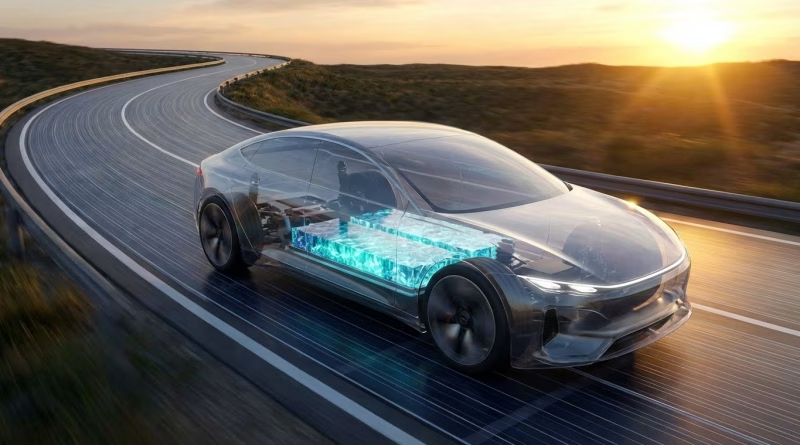
7 Explosive Solid-State Battery Breakthroughs Delivering Amazing EV Futures
On This Page
Get ready to ditch range anxiety and wave goodbye to painfully slow charging times. The electric vehicle (EV) revolution has been incredible, but there’s a new chapter unfolding, and it’s powered by solid-state battery breakthroughs. These innovative batteries are poised to completely redefine what we expect from our electric rides, promising a future where EVs are not just better, but truly unstoppable. In this post, we’re diving deep into seven explosive solid-state battery breakthroughs that are delivering amazing EV futures right before our eyes.
Unleashing Massive Energy Density: A Key Solid-State Battery Breakthrough
One of the most exciting solid-state battery breakthroughs directly addresses the biggest hurdle for many potential EV owners: range anxiety. Current lithium-ion batteries are great, but they’re inherently limited by their liquid electrolytes. Solid-state batteries, with their dense, stable solid electrolytes, can pack significantly more energy into the same or even smaller footprint. Imagine a sleek electric sedan that can genuinely travel 500, 600, or even 700 miles on a single charge – a distance previously reserved for gas guzzlers. This isn’t just about longer trips; it’s about enabling smaller, lighter battery packs, reducing overall vehicle weight, and freeing up crucial interior space. Companies like QuantumScape and Toyota are demonstrating prototypes that show this isn’t science fiction but imminent reality. This increased energy density means fewer charging stops and more spontaneous road trips, fundamentally changing the EV ownership experience.
Ultra-Fast Charging Times: Another Solid-State Battery Breakthrough Changing EVs
We’re all familiar with the “charging pit stop” challenge. While fast chargers are improving, getting a substantial charge often still means waiting 20-40 minutes. Another significant solid-state battery breakthrough is set to slash these times dramatically. The absence of liquid electrolytes eliminates the dendrite formation and side reactions that plague traditional batteries during rapid charging, allowing for much higher power input. We’re talking about charging an EV to 80% capacity in under 10-15 minutes – comparable to a quick gas station fill-up. This isn’t just a convenience; it’s a paradigm shift. If you can fully ‘refuel’ your car in the time it takes to grab a coffee, the practical objections to EV ownership start to evaporate. This technology promises to make EV travel as convenient, if not more so, than conventional gasoline vehicles. Imagine plugging in your car while you run a quick errand and coming back to a nearly full battery.
Unrivaled Safety Eliminating Thermal Runaway Fears
Safety is paramount in any vehicle, and solid-state battery breakthroughs offer a significant advantage here. Traditional lithium-ion batteries rely on flammable liquid electrolytes, which, if compromised, can lead to thermal runaway – a dangerous chain reaction resulting in fires. Solid-state batteries replace this volatile liquid with a non-flammable solid material, typically a ceramic, polymer, or sulfide. This inherent chemical stability drastically reduces the risk of fires or explosions, even if the battery is punctured or damaged in an accident. This enhanced safety isn’t just a perk; it’s a critical factor for widespread adoption and gives consumers peace of mind. For manufacturers, it simplifies safety regulations and potentially allows for more compact, innovative battery pack designs without the same level of fire suppression systems needed for liquid electrolyte batteries. This move towards safer battery architecture is a game-changer.
Phenomenal Durability and Extended Lifespan
Beyond safety, solid-state battery breakthroughs contribute significantly to the longevity and durability of electric vehicles. The stable solid electrolyte prevents many of the degradation mechanisms seen in liquid-electrolyte batteries, such as electrode corrosion and the formation of the solid-electrolyte interphase (SEI) layer which consumes active lithium over time. This means solid-state batteries are expected to maintain a higher percentage of their original capacity for far longer, extending the useful life of the EV itself. Imagine an EV battery that lasts 15-20 years with minimal degradation, potentially outliving the car’s body. This not only offers a better return on investment for consumers but also has massive implications for sustainability, reducing the frequency of battery replacement and recycling. Toyota, for instance, has publicly aimed for solid-state batteries that retain 90% of their capacity after 30 years.
Innovative Material Science Driving Sustainability and Cost Reductions
The pursuit of solid-state battery breakthroughs isn’t just about performance; it’s also a major push towards sustainability and cost efficiency. Researchers are exploring a wide array of solid electrolyte materials, many of which can reduce or eliminate the need for rare and expensive metals like cobalt. For example, some solid-state designs can accommodate anode materials like pure lithium metal, which offer higher energy density without the same supply chain complexities or ethical concerns associated with current battery chemistries. Furthermore, the simpler structure and potential for simpler manufacturing processes, once scaled, could lead to significant cost reductions over time. This innovative material science aims to create batteries that are not only powerful and safe but also more environmentally friendly throughout their lifecycle and ultimately more accessible to the mass market. This holistic approach makes solid-state a truly revolutionary technology.
What’s the Real Timeline for Solid-State Battery Mass Adoption?
So, with all these incredible solid-state battery breakthroughs, the obvious question is: when can we actually buy an EV with one? While significant progress has been made, particularly by companies like QuantumScape and Solid Power, mass production and widespread adoption are still a few years away. The challenges lie in scaling manufacturing processes, ensuring consistent quality, and bringing down costs to compete with established lithium-ion technology. Many experts predict initial deployments in premium or specialized vehicles by the mid-2020s, with broader consumer market penetration likely towards the end of the decade or early 2030s. Toyota, a frontrunner, aims to introduce solid-state battery EVs as early as 2027-2028, though initial volumes may be limited. The industry is in a race, and every new patent and prototype brings us closer. While we wait, the continuous advancements in existing lithium-ion tech also keep the EV market buzzing. It’s a fascinating time to watch this space, as the future of electric mobility is being forged by these revolutionary battery advancements. For more insights on the global research landscape, you can check out analyses from institutions tracking battery development worldwide. TechCrunch’s coverage on solid-state batteries offers excellent ongoing updates.