
7 Explosive OpenAI IPO Facts That Will Shock Investors
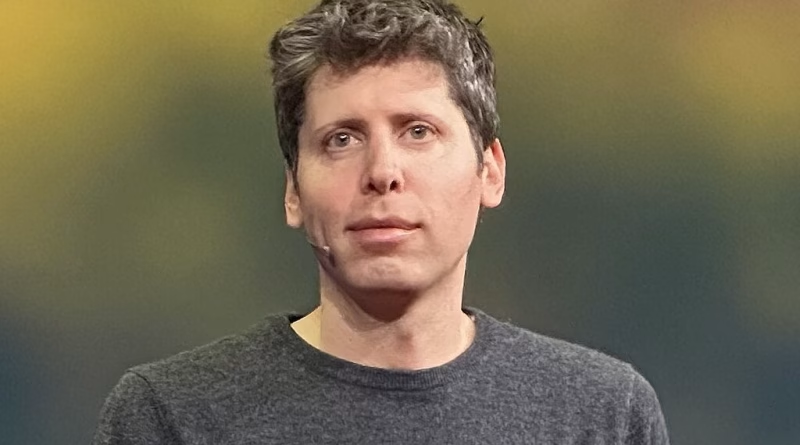
Featured Image: Steve Jurvetson, CC BY 2.0, via Wikimedia Commons
On This Page
The tech world stands on the precipice of another seismic shift, reminiscent of the dot-com era’s most electrifying public offerings. All eyes are now fixated on the impending OpenAI IPO, rumored to hit the markets with an astronomical $1 trillion valuation. This isn’t just another tech company going public; it’s a foundational moment for artificial intelligence, poised to redefine market dynamics and investor expectations. The journey from a research non-profit to a commercial behemoth with such a staggering projected worth is nothing short of revolutionary, igniting fervent discussions across every financial and technological forum.
As the whispers grow louder and the speculation reaches fever pitch, understanding the underlying currents shaping this monumental event is paramount. From its unprecedented valuation to the intricate web of intellectual property and strategic partnerships, the OpenAI IPO presents a unique tapestry of innovation, risk, and immense potential. Here are 7 critical facts that will undoubtedly shock investors and reshape our perception of what a tech launch can truly achieve.
The Valuation Enigma and Unprecedented Capitalization for the OpenAI IPO
The sheer scale of the rumored $1 trillion valuation for OpenAI is perhaps the most talked-about aspect. To put this in historical context, even the most legendary tech IPOs like Google (Alphabet Inc.) in 2004 or Facebook (Meta Platforms Inc.) in 2012 started with market caps significantly lower than this projected figure. Google’s IPO valued it at around $23 billion, while Facebook debuted at approximately $104 billion. The idea of OpenAI launching at a trillion-dollar valuation speaks volumes about the perceived transformative power of its core technology and the market’s insatiable appetite for AI dominance. This valuation isn’t merely speculative; it reflects deep-seated investor belief in AI’s future as a general-purpose technology.
Fact 1: The $1 Trillion Valuation, if realized, would place OpenAI among an elite cohort of companies like Apple, Microsoft, and Saudi Aramco from day one, an achievement unparalleled in tech history. This valuation is less about current revenue and more about future potential, essentially pricing in years, if not decades, of anticipated growth and market penetration across various industries.
Fact 2: A Dual-Class Share Structure is highly probable. Following in the footsteps of many Silicon Valley giants, OpenAI is expected to implement a dual-class share structure. This mechanism typically grants founders and early investors outsized voting power compared to public shareholders, ensuring long-term vision and strategic control amidst the pressures of public markets. This structure, a common feature in tech juggernauts like Google and Meta, allows core leadership to steer the company’s direction without being swayed by short-term market fluctuations, a crucial consideration for a company pushing the boundaries of AI research.
Critical IP and Market Position Beyond the OpenAI IPO Hype
OpenAI’s market position isn’t built on hype alone; it’s underpinned by a formidable arsenal of intellectual property and strategic alliances. The core of its value proposition lies in its groundbreaking generative AI models, which have already permeated global consciousness.
Fact 3: Key Patents and Proprietary Architectures are a goldmine. OpenAI’s vast portfolio of patents, particularly those pertaining to transformer architectures, large language models (LLMs), and reinforcement learning techniques, forms an impenetrable moat around its technological leadership. These aren’t just incremental improvements; they represent fundamental breakthroughs that have redefined the capabilities of AI. The deep learning breakthroughs, inspired by decades of neural network research, truly set OpenAI apart, making its intellectual property incredibly valuable for potential investors.
Fact 4: The Strategic Partnership with Microsoft is a game-changer. Microsoft’s multi-billion dollar investment and exclusive cloud computing partnership provide OpenAI with unparalleled computational resources and global distribution channels. This isn’t merely a financial transaction; it’s a symbiotic relationship where OpenAI gains scale and market access, while Microsoft integrates cutting-edge AI into its vast product ecosystem, from Azure to Office 365. This alliance not only de-risks OpenAI’s operational scaling but also amplifies its competitive edge against other tech giants.
Navigating Regulatory Hurdles for the OpenAI IPO
The rapid advancement of AI has inevitably drawn the attention of regulators worldwide. The OpenAI IPO will occur against a backdrop of increasing scrutiny over AI ethics, data privacy, and potential monopolistic practices. This landscape presents both challenges and opportunities.
Fact 5: Anticipated Regulatory Scrutiny will be intense. Governments are grappling with how to govern AI, from the European Union’s comprehensive AI Act to ongoing discussions in the US regarding responsible AI development. OpenAI will face significant pressure to demonstrate its commitment to ethical AI, transparency, and data governance. Its ability to proactively engage with regulators and establish industry best practices could become a key differentiator, influencing its public image and long-term market acceptance. The company’s non-profit origins and stated mission to benefit humanity will be tested against commercial imperatives and regulatory demands, requiring a delicate balance.
The Open-Source Dilemma and OpenAI’s Future Revenue Streams
OpenAI’s history as a non-profit dedicated to “open” AI research presents a fascinating paradox for its commercial future. Balancing its original ethos with the demands of public shareholders will be a critical act of corporate tightrope walking.
Fact 6: Balancing the “Open” Ethos with Monetization will be delicate. While its name suggests openness, much of OpenAI’s cutting-edge work is proprietary. The company has moved from an initial strategy of open-sourcing significant models to a more controlled release strategy, particularly for its most powerful advancements. This tension between accessibility and commercial advantage will be closely watched. Investors will demand clear pathways to profitability, while the AI community will continue to advocate for greater transparency and collaborative development. This balancing act will define its public perception and market strategy. For further reading on the complexities of open-source models in a commercial context, resources like the Open Science Framework offer valuable insights into the broader scientific community’s approach.
Fact 7: Diverse Future Revenue Streams are critical for sustaining valuation. Beyond the highly successful ChatGPT subscriptions and API access, OpenAI is actively exploring multiple avenues for revenue generation. This includes custom model training for enterprise clients, specialized AI solutions for specific industries (e.g., healthcare, finance), and potentially even hardware integration to run its models more efficiently at the edge. The diversification of its income sources will be vital to justify its hefty valuation and prove its longevity in a rapidly evolving market, ensuring that the initial OpenAI IPO capitalizes on a robust long-term strategy.
What Does an OpenAI IPO Mean for the Future of AI Innovation?
The impending OpenAI IPO is more than just a financial event; it’s a bellwether for the entire AI industry. It signals a maturation of generative AI from academic curiosity to a cornerstone of the global economy. This launch will inject unprecedented capital into AI research and development, potentially accelerating breakthroughs at a pace previously unimaginable. However, it also brings the pressures of public market expectations, potentially shifting focus from pure research to product commercialization and quarterly earnings. The challenge for OpenAI will be to maintain its pioneering spirit and commitment to ethical development while navigating the demands of shareholders. The success or struggles of this IPO will set a precedent for how future foundational AI companies are valued and perceived, shaping the trajectory of one of humanity’s most transformative technologies.