3 Explosive Imaging AI Startups Uncover Amazing Disease Detection
Hey tech fam, Tyler Brooks here, ready to blow your mind with another dose of future-forward insights! Ever feel like healthcare is still stuck in the stone age sometimes? Well, buckle up, buttercups, because that’s about to change in the most epic way possible. We’re talking about imaging AI startups that are literally rewriting the rulebook on how we find and fight diseases. These incredible pioneers are harnessing the raw power of artificial intelligence to spot health issues faster, more accurately, and with a precision that human eyes simply can’t match. Imagine a world where a life-threatening illness is caught before it even has a chance to fully develop. That’s not sci-fi anymore; it’s the groundbreaking reality these imaging AI startups are building right now. So, grab your virtual lab coats, because we’re diving deep into three mind-blowing ways machines are detecting disease faster than ever before.
The Microscopic Detectives: How Imaging AI Startups Catch Cancer Early
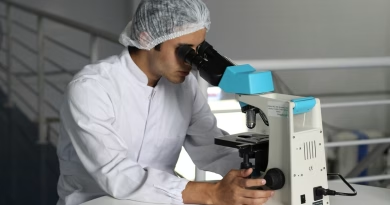
Let’s start with the big C – cancer. It’s a word that strikes fear into hearts globally, but what if detecting it could be as routine and painless as, well, not painful at all? This is where the magic of imaging AI startups truly shines. Traditionally, pathologists spend hours, often days, meticulously examining biopsy slides under a microscope, looking for tell-tale signs of malignancy. It’s a grueling, error-prone task, and even the most experienced human eye can miss subtle indicators. Enter AI. These super-smart algorithms are trained on vast datasets of medical images – think thousands upon thousands of cancer samples and healthy tissues. They learn to identify patterns, anomalies, and microscopic nuances that are invisible to us mortals. For instance, companies like Paige.AI are using computational pathology to analyze digital slides. Instead of just assisting, the AI acts like a tireless, hyper-focused detective, sifting through millions of data points on a slide in seconds. It can highlight suspicious areas, quantify tumor growth, and even predict how aggressive a cancer might be, all long before a human could even finish their first cup of coffee. This isn’t just about speed; it’s about unparalleled accuracy, catching those tiny rogue cells that could mean the difference between early intervention and a much tougher battle. Early detection is king when it comes to cancer, and these imaging AI startups are giving us a crown made of data.
Beyond the Eye: Unmasking Hidden Heart Issues with Advanced Imaging AI
Next up, let’s talk about the ticker – your heart. Cardiovascular diseases remain a leading cause of death worldwide, and often, symptoms only become apparent when the damage is already significant. Traditional diagnostic tools like ECGs and even MRIs require highly specialized interpretation, and human variability can lead to missed diagnoses or delayed treatments. This is another frontier where imaging AI startups are making colossal waves. Imagine AI analyzing your cardiac MRI or CT scans not just for visible blockages, but for subtle changes in tissue texture, blood flow dynamics, or early signs of structural weakness that are too minute for human radiologists to consistently spot. Startups are developing AI models that can precisely segment cardiac structures, measure ejection fractions, and even predict future cardiac events based on complex patterns in imaging data. For example, a company might use AI to detect early signs of cardiomyopathy or arterial calcification years before they become critical, allowing for preventative measures or lifestyle changes. This isn’t just about looking at an image; it’s about extracting a narrative of your heart’s health, predicting its future chapters, and empowering doctors to intervene proactively. The precision offered by advanced imaging AI means that fewer critical conditions go unnoticed, potentially saving countless lives and drastically improving quality of life for millions.
Predicting the Unpredictable: Neurodegenerative Disease Insights from AI
Our final stop on this mind-bending tour takes us to the brain – the ultimate black box. Neurodegenerative diseases like Alzheimer’s, Parkinson’s, and MS are notoriously difficult to diagnose early, primarily because their symptoms often overlap and progression can be slow and insidious. By the time clear clinical signs emerge, significant neurological damage may have already occurred. This is where the predictive power of imaging AI startups is nothing short of revolutionary. AI algorithms are being trained on massive datasets of brain scans – MRIs, PET scans, even functional MRIs – alongside patient histories and genetic markers. They can identify incredibly subtle changes in brain volume, white matter integrity, and metabolic activity that might indicate the very earliest stages of a neurodegenerative condition. These changes can be years, even decades, ahead of any cognitive decline a patient might experience. For instance, AI could analyze a routine brain MRI and flag a potential risk for Alzheimer’s based on intricate patterns of brain atrophy in specific regions. This kind of early insight is invaluable. It opens doors for clinical trials of new therapies, allows patients to plan for their future, and potentially enables interventions that could slow or even halt disease progression before it takes a devastating toll. It’s about shifting from reactive treatment to proactive prevention, giving both patients and clinicians a powerful new weapon against these challenging diseases.
The Game-Changers: Why Imaging AI Startups Are Redefining Diagnostics
So, what ties all these incredible advancements together? It’s the agile, innovative spirit of imaging AI startups. Unlike established healthcare giants, these lean, mean, tech-driven machines can pivot quickly, embrace cutting-edge algorithms, and focus intently on solving specific, critical problems within medical diagnostics. They’re attracting top-tier AI talent and venture capital, fueled by the undeniable potential to transform healthcare. These companies aren’t just building tools; they’re building entirely new paradigms for how we approach disease. They’re democratizing access to expert-level diagnostics, potentially bringing advanced screening capabilities to underserved regions. Furthermore, the continuous learning aspect of AI means these systems only get better over time, refining their accuracy with every new scan they analyze. This constant improvement cycle is something no human diagnostic team, however brilliant, can replicate. It’s a dynamic, evolving intelligence that promises a future where a missed diagnosis becomes a relic of the past, and proactive health management is the norm.
Are We Ready for an AI-Powered Healthcare Revolution?
The short answer? We HAVE to be. The potential of imaging AI startups to detect disease faster and more accurately isn’t just a technological marvel; it’s a moral imperative. As these technologies mature and become more integrated into clinical practice, we’ll see a dramatic shift in patient outcomes, healthcare efficiency, and overall public health. Of course, there are challenges – data privacy, regulatory hurdles, ethical considerations – but the momentum is undeniable. We’re on the cusp of a healthcare revolution, powered by artificial intelligence, and it’s going to be one wild, life-saving ride. What do you think? Are you ready to trust machines with your health? Let me know in the comments below!