
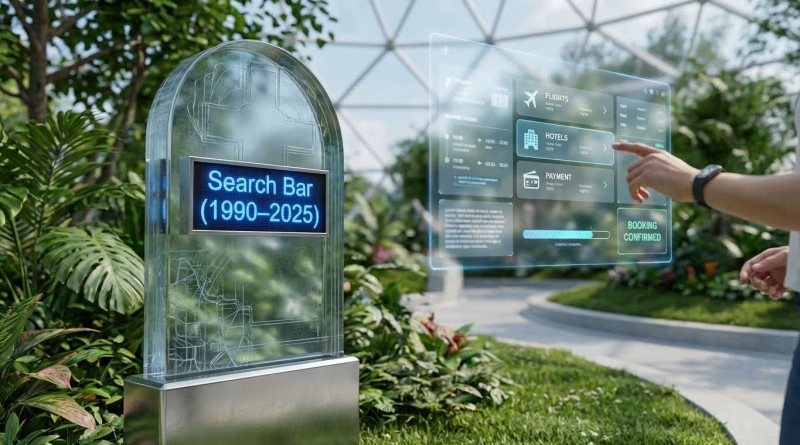
5 Shocking Secrets to How Agentic Apps are Killing the Search Bar in 2026
On This Page
For nearly thirty years, the “Search Bar” was the undisputed front door to the internet. If you wanted to know something, buy something, or go somewhere, you typed keywords into a box and sifted through a list of blue links. But as we move deeper into 2026, that door is being boarded up. We are witnessing the “Death of the Search Bar,” driven by the rapid rise of agentic apps.
We are no longer satisfied with being given a map to the information; we want the information brought to us. Even more, we want the action completed for us. This is the fundamental promise of the “Agentic Web.”
What Are Agentic Apps?
Unlike the “copilots” of 2024 which simply suggested text or code, agentic apps are autonomous systems. They don’t just search; they do. An agentic app can navigate websites, fill out forms, interact with checkout pages, and synthesize data from multiple sources without you ever needing to click a single link.
In 2026, the industry has shifted from “finding” to “executing.” Here is how this shift is killing the search bar as we know it.
1. The Rise of the “Browse for Me” Era
Leading the charge are browsers like Arc (Dia) and Perplexity Comet. Instead of showing you a list of results, these agentic apps use a feature called “Browse for Me.” You provide a goal—“Find me the best lightweight laptop for a graphic designer under $1,500”—and the agent reads fifteen different review sites, compares specs, checks local stock, and presents you with a custom-generated report. The search bar has been replaced by a goal-oriented command center.
2. From Search Results to Direct Actions
The true power of agentic apps in 2026 is their ability to cross the “action gap.” With the release of ChatGPT Atlas (OpenAI’s agentic browser), you can tell your AI: “Book me a table for four at a highly-rated Italian place tonight at 7 PM and send the invite to my friends.” The agent doesn’t give you a Yelp link. It goes to the restaurant’s booking site, navigates the calendar, confirms the reservation, and accesses your contacts to send the invites. You didn’t search; you commanded.
3. The “Zero-Click” Future and the Brand Crisis
This shift creates a massive challenge for the old internet. If agentic apps are doing the browsing, traditional “click-through rates” (CTR) are plummeting. This is known as the “Zero-Click” future.
In 2026, brands are no longer optimizing for “keywords” to catch a human’s eye; they are optimizing for “entities” to be picked up by an AI agent’s reasoning engine. If your website isn’t “agent-friendly,” you are effectively invisible to the modern user.
4. Personalization via Long-Term Memory
In 2025, search was “stateless”—every time you searched, you started fresh. In 2026, agentic apps have persistent memory. They know your budget, your aesthetic preferences, your past purchases, and your schedule. When you ask an agentic app to find you a gift for your spouse, it doesn’t search “best gifts 2026”; it cross-references your spouse’s “liked” posts on social media with your recent bank statements to find something truly personal.
Why the Search Bar Won’t Survive 2027
The convenience of agentic apps is an addictive one-way street. Once you have experienced a web where the “grunt work” of clicking, reading, and comparing is handled by a tireless digital agent, going back to a list of links feels like using a rotary phone.
The search bar was a tool for an era when humans had to be the connective tissue of the internet. In 2026, the AI is the tissue. We are no longer the ones browsing the web; we are the ones directing the agents who do.