
The 5 Shocking Ways AI-Native Startups are Disrupting Venture Capital in 2026
On This Page
Have you ever been curious about AI-native startups? For decades, the “Unicorn” (a startup valued at $1 billion) was a symbol of massive scale: hundreds of engineers, floors of salespeople, and millions in venture capital to keep the lights on. But as we start 2026, that definition is being shredded. We are witnessing the rise of the Solo Unicorn—billion-dollar companies built and run by a single founder.
The secret behind this shift is the emergence of AI-native startups. These aren’t just traditional companies using a little bit of AI to speed up tasks; these are businesses built from the ground up where AI is the primary worker. This structural shift is sending shockwaves through the venture capital world.

The Era of the AI-Native Architecture
To understand the Solo Unicorn, you must understand the difference between being “AI-enhanced” and being “AI-native.”
- AI-Enhanced: A company with 50 employees that uses ChatGPT to write emails faster.
- AI-Native Startups: A company with one founder where the core product, the customer support, the lead generation, and the software development are all handled by autonomous AI agents.
In 2026, AI-native startups operate with profit margins that traditional software-as-a-service (SaaS) companies can only dream of. When your “payroll” consists of API tokens rather than six-figure salaries and health benefits, you can scale to millions in revenue with almost zero overhead.
5 Ways AI-Native Startups are Disrupting Venture Capital
- The End of the “Headcount” Metric: For years, VCs judged a startup’s success by how fast it was hiring. In 2026, high headcount is seen as a liability—a sign of inefficiency. Investors now look for “Revenue Per Human,” and the Solo Unicorns are breaking the charts.
- Collapsing Seed Rounds: Why raise a $2 million seed round to hire a team when an AI-native founder can build the MVP (Minimum Viable Product) and reach the first $100k in ARR (Annual Recurring Revenue) for the cost of a few server subscriptions? This is forcing VCs to move much earlier or find new ways to provide value.
- The “Vibe Coding” Revolution: Tools like Lovable and Bolt have allowed non-technical founders to build complex, enterprise-grade software through natural language. This has expanded the pool of potential unicorn founders from “Silicon Valley engineers” to anyone with deep domain expertise and a vision.
- Speed to Market: Traditional startups take years to reach unicorn status. In 2025 and 2026, we’ve seen AI startups hit $1 million ARR in a median of 11 months—nearly four times faster than the peak of the SaaS boom.
- Solo-Cap Tables: Solo founders no longer need to give away 50% of their company to a co-founder and an early team. This means that even a “small” exit or a lower valuation makes the solo founder incredibly wealthy, changing the incentives for taking on venture capital in the first place.
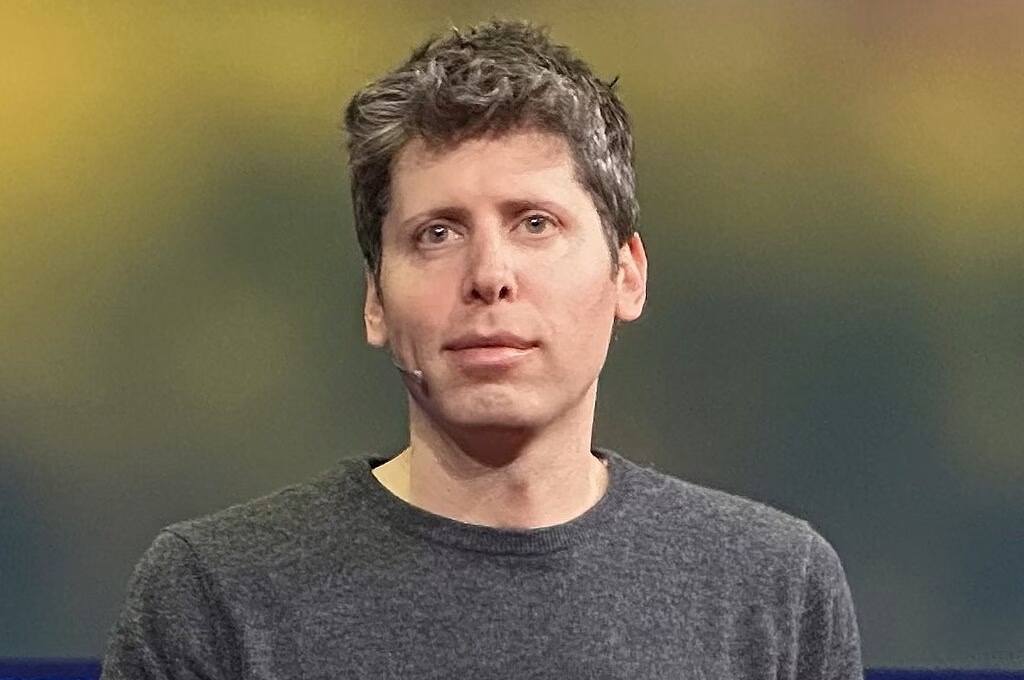
Image: Steve Jurvetson, CC BY 2.0 , via Wikimedia Commons
The Sam Altman Prediction Comes True
OpenAI CEO Sam Altman famously predicted a one-person billion-dollar company would appear between 2026 and 2028. We are seeing the early winners of this race now. These founders act as “Chief Visionary Officers,” spending their days orchestrating fleets of agents rather than managing people.
They use AI-native startups to find “boomer businesses” (industries with low tech adoption like local real estate or accounting) and automate them entirely. By the time the incumbents realize what’s happening, the solo founder has already captured the market.
Is the Human Employee Obsolete?
The rise of the Solo Unicorn doesn’t mean humans are gone; it means the role of the human has shifted. In 2026, the most successful entrepreneurs are those who can “speak AI”—the ones who know how to chain agents together and manage a digital workforce.
Venture capital isn’t dying, but it is evolving. Investors are moving away from funding “teams” and toward funding “architectures.” The question for the next generation of founders is no longer “Who do I need to hire?” but “What agents do I need to build?”