Biodegradable Electronics: Can Science Solve E-Waste?
As global e-waste piles up, scientists are developing biodegradable electronics that can break down safely after use. In 2025, how close are we to real eco-friendly tech?
Read More
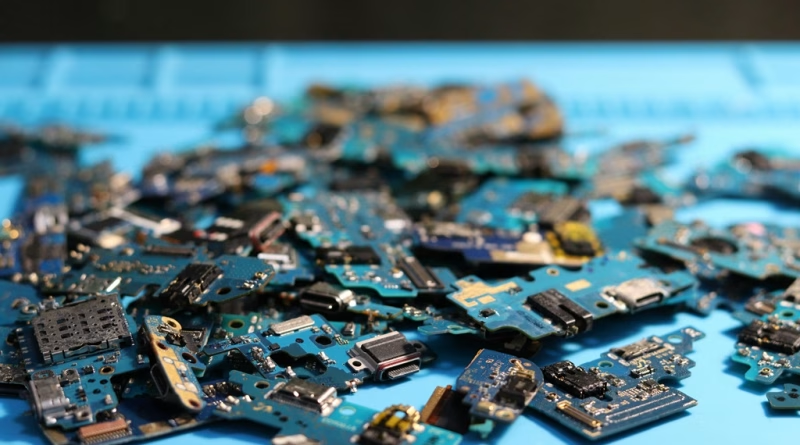
As global e-waste piles up, scientists are developing biodegradable electronics that can break down safely after use. In 2025, how close are we to real eco-friendly tech?
Read More
In 2025, black hole research has reached new depths—literally. From real-time feeding events to jet formation mysteries, here’s what astronomers have uncovered this year.
Read More
AI is revolutionizing archaeology. In 2025, machine learning is helping researchers uncover lost cities, decode ancient texts, and map ruins—faster than ever before.
Read More
Want to help with real scientific research from your laptop? In 2025, citizen science is booming. Here are the best online projects you can join—from space exploration to wildlife tracking.
Read More
The lithium-ion battery revolution powered smartphones and EVs—but what comes next? From solid-state to sodium and silicon, here’s what’s replacing lithium-ion in 2025 and beyond.
Read More
Fusion energy has long been the ultimate power promise. But in 2025, is it still just 30 years away—or finally within reach? Here’s where fusion tech really stands now.
Read More
3D printing isn’t just for prototypes anymore. In 2025, it’s helping solve the organ shortage crisis. Here’s how bioprinting is transforming transplants—what’s real, and what’s next.
Read More
Mars colonization once seemed just around the corner—but delays have shifted the roadmap. Here’s what’s behind schedule, what’s on track, and what’s really next for humanity’s red frontier.
Read More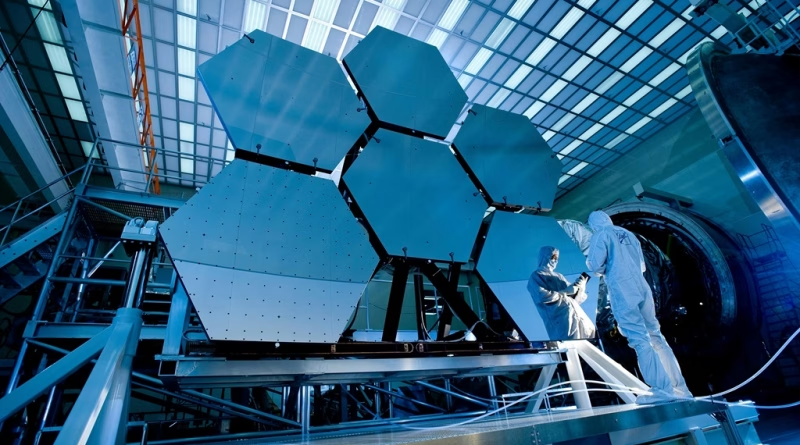
From ancient galaxies to possible signs of life, the James Webb Space Telescope is rewriting astronomy. Here’s what it’s found in 2025—explained without the jargon.
Read More
You’ve heard of CPUs and GPUs, but what is an NPU? We explain what a Neural Processing Unit is, how it works, and why it’s the key to the new generation of “AI PCs.”
Read More