7 Incredible Facts About Europa’s Icy Moon That Promise Amazing Discoveries
On This Page
Hey tech explorers! Olivia Carter here, and today we’re diving into one of the most exciting space missions on the horizon: the Europa Clipper. If you’re into groundbreaking science, advanced engineering, and the quest for life beyond Earth, then Europa’s Icy Moon is where the action is. This mission isn’t just another trip to a distant world; it’s a deep probe into the mysteries of Jupiter’s enigmatic satellite, Europa. Get ready to uncover 7 incredible facts about Europa that make the upcoming Europa Clipper mission an absolute game-changer.
The Shocking Secret Beneath Europa’s Icy Moon Shell
One of the most jaw-dropping revelations about Europa is the existence of a massive global ocean hidden beneath its kilometers-thick icy crust. Imagine this: a body of saltwater, potentially twice the volume of all Earth’s oceans combined, encapsulated by a shell of ice. This isn’t just a puddle; it’s a vast, deep sea. For decades, scientists suspected it, but data from NASA’s Galileo mission provided compelling evidence, hinting at an environment that could harbor life. The sheer scale and presence of liquid water make Europa’s Icy Moon a prime target in the search for extraterrestrial biology. We’re talking about a potential alien ocean right in our cosmic backyard!
Tidal Forces and Plumes: Europa’s Dynamic Engine
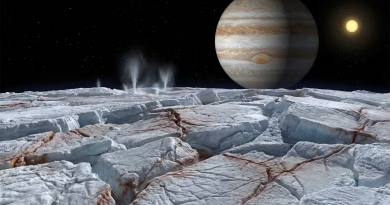
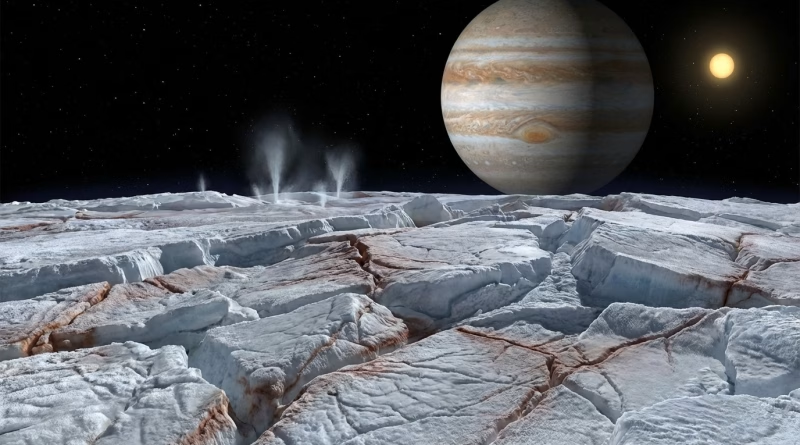
What keeps this colossal ocean from freezing solid in the frigid outer solar system? The answer lies with Jupiter, Europa’s gargantuan parent planet. Jupiter’s immense gravitational pull creates powerful tidal forces that constantly stretch and squeeze Europa. This internal friction generates heat – much like bending a paperclip back and forth until it gets warm. This “tidal heating” is crucial; it prevents the subsurface ocean from freezing and could also drive hydrothermal vents on Europa’s seafloor, similar to those that support diverse ecosystems in Earth’s deep oceans. Even more astonishing are the detected plumes of water vapor and icy particles erupting from Europa’s south polar region. These geysers, first observed by the Hubble Space Telescope, suggest that material from the subsurface ocean might be directly venting into space. This is huge! It means Europa Clipper could potentially sample the ocean’s chemistry without even needing to drill through the thick ice.
Europa Clipper’s Unprecedented Tech for Unlocking Secrets of Europa’s Icy Moon
To unravel Europa’s secrets, NASA is deploying the Europa Clipper, a spacecraft packed with an arsenal of cutting-edge instruments. This isn’t your average probe; it’s a mobile laboratory designed for extreme conditions. It includes a sophisticated ice-penetrating radar to map the thickness of the ice shell and locate the ocean. A magnetometer will measure Europa’s magnetic field, which could confirm the salinity and depth of the ocean. High-resolution cameras and spectrometers will scrutinize the surface for geological features, potential landing sites, and the chemical composition of the plumes. Each instrument is a marvel of engineering, built to operate in Jupiter’s harsh radiation environment and gather unprecedented data about this fascinating world. Think of it as a Swiss Army knife for planetary science, ready to tackle any mystery Europa’s Icy Moon throws at it.
The Grand Tour: A Mission Built for Survival and Discovery
The journey to Europa is fraught with challenges, primarily due to Jupiter’s incredibly intense radiation belts. Direct orbit around Europa would quickly fry any electronics. So, NASA engineers devised an ingenious solution: Europa Clipper will perform nearly 50 close flybys of Europa over its mission lifetime. It will execute long, looping orbits around Jupiter, swooping in close to Europa for brief, intense periods of data collection, then retreating to safer distances. This “Grand Tour” approach minimizes radiation exposure while maximizing scientific return. It’s a cosmic dance, meticulously choreographed to protect the spacecraft while gathering the vital information needed to understand this incredible world. The mission is set to launch aboard a SpaceX Falcon Heavy rocket, showcasing modern spaceflight capabilities in pursuit of deep space discovery.
Why Europa’s Icy Moon is Our Best Bet for Extraterrestrial Life
When we talk about life beyond Earth, Europa consistently rises to the top of the list, and for excellent reasons. Scientists believe the conditions for life — liquid water, essential chemical elements, and an energy source — could all be present in Europa’s subsurface ocean. The interaction between the ocean and a rocky seafloor, heated by tidal forces, could create hydrothermal vents much like those on Earth that host thriving ecosystems in total darkness. The potential for a sustained, chemically rich environment, sheltered from harsh surface radiation, makes Europa incredibly compelling. It’s not just about finding microbes; it’s about understanding the fundamental requirements for life itself and whether it’s a common occurrence in the universe. The data from Europa Clipper could fundamentally shift our perspective on astrobiology. You can dive deeper into the mission’s objectives and the science behind them on the official NASA Europa Clipper website.
What Groundbreaking Insights Will Europa Clipper Uncover Next?
The Europa Clipper mission is more than just a scientific endeavor; it’s a testament to human curiosity and technological prowess. As it embarks on its journey, set to arrive in the Jupiter system around 2030, the anticipation within the scientific community is palpable. We’re not just sending a probe; we’re sending our hopes and questions to a world that could hold answers to some of humanity’s most profound queries: Are we alone? The data it transmits back promises to be a treasure trove, confirming the ocean’s properties, characterizing its habitability, and perhaps even detecting the tell-tale signs of biological activity. Every piece of information will contribute to a more complete picture of Europa, pushing the boundaries of our knowledge and inspiring future missions – perhaps even one that lands on the ice or sends a submersible into its alien ocean. The adventure is just beginning, and the insights from Europa Clipper will undoubtedly shape the next chapter of space exploration.