5 Explosive MMX Martian Moon Mission Goals Revolutionizing Space Exploration
Japan Aerospace Exploration Agency (JAXA) is on the cusp of an interstellar triumph with its Martian Moons eXploration (MMX) mission. This isn’t just another space probe; it’s a strategically engineered endeavor targeting Phobos, Mars’ enigmatic inner moon, with an audacious Phobos sample return goal that could fundamentally reshape our understanding of the solar system. The MMX Martian Moon Mission, slated for launch in 2024, represents a monumental leap in planetary science and space technology.
As an analytical observer of tech and scientific advancements, the MMX mission stands out not merely for its technical complexity but for the sheer breadth of its scientific objectives. This mission is designed to retrieve upwards of 10 grams of Phobos regolith, a feat of precision engineering that builds upon the successes of prior sample return endeavors like Hayabusa2. The data derived from these pristine samples promises to be nothing short of revolutionary. Let’s dissect the five explosive goals that position the MMX Martian Moon Mission at the forefront of contemporary space exploration.
1. Decoding Phobos’ Genesis: A Cosmic Conundrum
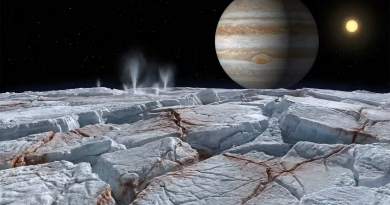
One of the most profound mysteries surrounding Mars’ moons, Phobos and Deimos, is their origin. Two primary hypotheses prevail: either they are captured asteroids, gravitationally snared from the main asteroid belt, or they are re-accreted fragments of Mars itself, ejected during a colossal impact event. The MMX Martian Moon Mission aims to provide the definitive answer. Current spectroscopic observations from Earth and orbiting spacecraft offer tantalizing, yet inconclusive, clues. Phobos, with its potato-like dimensions of approximately 27 × 22 × 18 km, exhibits spectral similarities to D-type asteroids, which are carbon-rich and common in the outer asteroid belt. However, its low density (around 1.87 g/cm³) complicates this narrative.
By bringing a physical sample back to terrestrial laboratories, scientists can perform detailed isotopic and mineralogical analyses with unparalleled precision. If the samples show a distinct composition from Martian rock, aligning instead with primitive asteroid material, the capture theory gains significant traction. Conversely, if the samples bear the geochemical signature of Mars, it would strongly support the impact-ejection model. This resolution is critical not only for understanding Phobos and Deimos but also for modeling planetary formation processes across the solar system, where similar moon formation mechanisms are still debated.
2. Unlocking Mars’ Early History: Phobos as a Time Capsule
Mars today is a cold, arid desert, but evidence points to a dramatically different past, with liquid water abundant on its surface. Directly sampling Mars’ surface for ancient hydrological and atmospheric clues is immensely challenging due to millennia of surface alteration by solar radiation and dust storms. Phobos, however, offers a unique alternative. Positioned in a low orbit (roughly 6,000 km above Mars’ surface), Phobos has been continuously bombarded by material ejected from Mars over billions of years. These tiny fragments of Martian rock and dust have accumulated on Phobos’ surface, essentially creating a geological “flypaper” for ancient Martian material.
The MMX Martian Moon Mission’s samples will likely contain not just Phobos’ native material but also a significant percentage of Martian ejecta. By analyzing these particles, scientists can gain direct insights into the composition of Mars’ crust and mantle from billions of years ago. This could include hydrated minerals indicative of past water activity, organic molecules, or even signs of ancient microbial life, preserved from a time when Mars was potentially habitable. The statistical probability of finding such pristine, ancient Martian material within the regolith makes Phobos an invaluable scientific archive, potentially offering a clearer window into Mars’ formative years than any direct Mars rover has yet provided.
3. Advancing Sample Return Technology: Precision and Purity
The technical demands of the MMX Martian Moon Mission are extraordinary. Retrieving a sample from Phobos, a body with incredibly weak gravity (less than 1/1000th of Earth’s), requires a new generation of autonomous navigation and precision landing systems. The mission involves complex maneuvers, including orbital insertion around Mars, close-proximity operations near Phobos, multiple touch-downs for sample collection, and an intricate return trajectory to Earth. JAXA’s experience with Hayabusa and Hayabusa2, which successfully returned samples from asteroids Itokawa and Ryugu, provides a foundational but not exhaustive blueprint.
MMX will incorporate advanced robotic manipulators and specialized sampling devices designed to collect material from two different locations on Phobos, enhancing the scientific diversity of the return. Furthermore, the mission will deploy a small rover, developed in collaboration with DLR (German Aerospace Center) and CNES (French Space Agency), to conduct in-situ surface science. The development and execution of these technologies will push the boundaries of robotic autonomy and deep-space mission design, achieving previously unattainable levels of precision in celestial body interaction. The lessons learned will be instrumental for future missions requiring delicate sample acquisition from low-gravity environments, contributing directly to an overall increase in sample return mission success rates, which currently stand around 60% for interplanetary efforts.
4. Catalyzing Human Deep-Space Exploration: A Stepping Stone
Beyond its profound scientific contributions, the MMX Martian Moon Mission serves as a critical pathfinder for future human missions to Mars and beyond. Phobos, with its proximity to Mars, low gravity, and relatively predictable orbital mechanics, is considered by many as a prime candidate for a “precursor” human outpost before tackling the Red Planet itself. Understanding the radiation environment, regolith properties, and potential resource availability (e.g., water ice, which could be processed for fuel or life support) on Phobos is paramount for planning long-duration human expeditions.
The MMX mission will provide invaluable data on the radiation levels in Mars’ vicinity, crucial for designing protective habitats and optimizing crew health protocols. Furthermore, the mission tests technologies and operational procedures that will be directly transferable to crewed missions, such as autonomous navigation, rendezvous, and docking in complex gravitational fields. A successful MMX Phobos sample return demonstrates the capability to not only visit and explore these distant objects but to return safely with valuable resources and data, significantly reducing the technological and logistical risks for future human endeavors. This mission effectively acts as a critical dress rehearsal for humanity’s eventual journey to the Martian system.
5. Quantifying Dust Dynamics in the Martian System: An Environmental Study
Mars is renowned for its planet-spanning dust storms, and its atmosphere is a dynamic, complex system. The MMX mission will investigate how Martian dust interacts with its moons. As Phobos orbits Mars at an average altitude of 6,000 km, it passes through the outermost fringes of the Martian atmosphere. This interaction, along with impacts from micrometeoroids, causes dust particles to be constantly transferred between Mars and its moons, and within the Mars-Phobos system. Understanding this dust transport mechanism is vital for several reasons.
Firstly, it helps contextualize the geological evolution of Phobos itself, providing insights into its surface weathering and regolith formation. Secondly, the study of how dust moves and settles provides critical environmental data for future human missions, as dust poses significant engineering and health challenges. Fine, abrasive dust can degrade equipment, obscure solar panels, and pose respiratory risks to astronauts. The MMX mission’s instruments, including a dust monitor and a gamma-ray and neutron spectrometer, will characterize the physical and compositional properties of dust in orbit and on Phobos’ surface. This quantitative data will offer unprecedented insights into the Martian atmospheric escape processes and orbital dynamics of dust, allowing for more robust planning for both robotic and crewed missions, ensuring we are better prepared for a roughly 90% chance of encountering dust-related operational challenges on any long-duration Mars mission.
Beyond the Red Planet: What Uncharted Territories Will MMX Unlock for Humanity?
The JAXA MMX Martian Moon Mission is more than a simple sample return; it is a meticulously planned, multi-faceted scientific and technological endeavor that promises to deliver an unprecedented trove of data. From unraveling the enigmatic origins of Phobos to serving as a vital precursor for human interplanetary travel, its five core objectives are poised to redefine our understanding of the Martian system and beyond. The successful return of Phobos samples will not only provide definitive answers to long-standing questions but will also equip us with the knowledge and technologies necessary for humanity’s continued expansion into the cosmos. As we eagerly await its launch, the MMX mission stands as a testament to human ingenuity and our insatiable drive to explore the unknown. For more detailed insights, you can explore the official JAXA MMX mission page.