
5 Explosive Ways Smart Glasses Are Amazingly Replacing Screens
On This Page
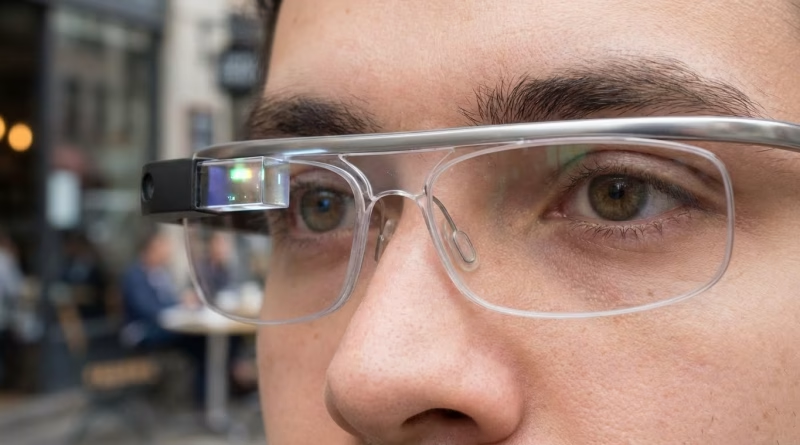
The dawn of a new era in human-computer interaction is not merely at our doorstep; it is quite literally unfolding before our eyes, thanks in no small part to innovations like the Meta Ray-Ban Display. We stand at a pivotal juncture where the traditional rectangular screens that have defined our digital lives for decades are beginning to cede ground to a more integrated, ambient form of technological engagement. This profound shift, heralded by advanced wearables, means that smart glasses are replacing screens as our primary interface, ushering in a future where digital information seamlessly merges with our physical reality.
From the early days of cathode ray tubes to the ubiquitous OLED panels dominating our pockets and desks, the display has always been an explicit barrier between the user and the digital realm. It demanded our focused attention, often pulling us away from our immediate environment. However, the sophisticated capabilities of modern smart glasses are fundamentally altering this dynamic, promising a world where the screen dissolves, and data becomes an intrinsic layer of our perception. This isn’t just an evolutionary step; it’s a revolutionary leap that promises to redefine how we perceive, interact with, and integrate technology into our daily existence. Let’s delve into five massive ways smart glasses are replacing screens and reshaping our digital landscape.
The Ambient Information Overlay: Merging Digital with Reality
One of the most immediate and impactful transformations brought about by smart glasses is their capacity to provide an ambient information overlay, effectively eliminating the need to consult a separate device for data. Imagine navigating a bustling city street, and directions appear as illuminated arrows on the pavement before you, or receiving a critical message discreetly projected into your peripheral vision, without ever breaking eye contact or pulling out a smartphone. This is the promise of augmented reality (AR) and mixed reality (MR) delivered through eyewear. Historically, our interaction with digital information has been tethered to a distinct physical display. From the early Punch Card machines of the 19th century to the terminal screens of the mainframe era, information was always “elsewhere.” Smart glasses shatter this paradigm, contextualizing data directly within our visual field. Think of real-time language translations appearing as subtitles over a foreign speaker, or identifying a plant simply by looking at it – all without the disruptive act of pulling out a phone. This integration allows for a continuous flow of information, enhancing our perception rather than distracting from it. Smart glasses are replacing screens by making information access utterly seamless and environmentally aware.
Redefining Communication and Social Interaction
The ubiquity of smartphones has, paradoxically, created a social barrier, with individuals often more engrossed in their device than their immediate company. Smart glasses offer a compelling antidote, redesigning how we communicate to be more natural and less intrusive. Hands-free video calls, discreet messaging, and the ability to capture photos or videos from a first-person perspective without the obtrusive action of holding up a phone are transformative. Consider the subtle notification of an incoming message, visible only to the wearer, or the ability to share a live perspective with a loved one without interrupting a shared moment. This method of communication respects the integrity of real-world interactions while still providing robust digital connectivity. The historical trajectory of communication tools, from telegraphs to telephones to video conferencing, has consistently aimed for more immediate and less mediated exchange. Smart glasses represent the pinnacle of this aspiration, allowing us to maintain eye contact and genuine presence while remaining connected. This is a crucial way smart glasses are replacing screens – by making digital interaction blend almost invisibly into social etiquette.
Seamless Navigation and Contextual Awareness
Navigation has undergone a fascinating evolution, from cumbersome paper maps to the in-car GPS systems of the late 20th century, and then to the handheld smartphone applications that now guide millions daily. Smart glasses herald the next logical iteration, offering truly immersive and contextual navigation. Instead of consulting a map on a small screen, directions are overlaid directly onto the world around you – arrows on the road, highlights on landmarks, or floating markers indicating points of interest. This isn’t merely turn-by-turn guidance; it’s an enhanced spatial awareness that can identify historical facts about buildings as you pass them, or display real-time transit information as you approach a bus stop. The capacity for smart glasses to provide such rich, context-aware information liberates us from the constant need to glance at a secondary device, allowing us to remain fully engaged with our surroundings. The development of sophisticated Simultaneous Localization and Mapping (SLAM) algorithms further enhances this capability, ensuring precise and reliable spatial anchoring. This effortless access to location-based data is yet another profound way smart glasses are replacing screens, making our interaction with the physical world more informed and intuitive.
Empowering Health and Wellness Monitoring
The health and fitness industry has been profoundly impacted by wearable technology, yet many devices still rely on a secondary screen – either their own tiny display or a synced smartphone – to present data. Smart glasses integrate biometric sensing with immediate visual feedback, creating a seamless health monitoring experience. Imagine a runner seeing their heart rate, pace, and distance projected onto their immediate view without breaking stride to check a watch, or an individual with diabetes having their glucose levels discreetly displayed. Beyond personal metrics, these devices can offer vital assistance, such as object recognition for the visually impaired or real-time vital sign monitoring for elderly care. The integration of advanced sensors directly into eyewear marks a significant departure from standalone devices, making health data more accessible and less of an interruption. This convergence of monitoring and display within a single, natural form factor underscores how smart glasses are replacing screens, turning personal health data into an ambient part of our daily awareness rather than an explicit query. For a deeper dive into the technological underpinnings of AR and its health applications, consider exploring resources from academic journals or industry leaders in spatial computing.
The Future of Productivity and Hands-Free Computing
The traditional workstation, with its multiple monitors, keyboards, and mice, has long been the bastion of productivity. Smart glasses challenge this paradigm by offering the potential for virtual multi-monitor setups, accessible anywhere. Imagine sitting at a coffee shop and virtually manifesting several large displays around you, interacting with complex 3D models or spreadsheets through gesture controls and voice commands, all without a physical screen in sight. This hands-free computing paradigm extends beyond the office, revolutionizing industrial applications where workers can follow step-by-step assembly instructions overlaid onto machinery, or conduct remote inspections with expert guidance appearing in their field of view. The historical progression of input methods, from punch cards to keyboards to touchscreens, now points towards more intuitive, embodied interactions. Smart glasses integrate these next-gen interfaces, enabling a level of productivity that is both flexible and powerful, untethered from fixed physical displays. This fundamental shift demonstrates how smart glasses are replacing screens to empower a truly mobile and immersive computing experience, fundamentally altering our relationship with digital workspaces.
Are We Prepared for a Screen-Agnostic Digital Existence?
The advent of smart glasses, epitomized by devices like the Meta Ray-Ban Display, signifies more than just another gadget; it represents a profound evolutionary step in our symbiotic relationship with technology. By elegantly dissolving the explicit barrier of the screen, these devices promise a future where digital information is not just accessed but experienced, seamlessly woven into the fabric of our physical reality. The implications for privacy, cognitive load, and the very nature of human perception are vast and warrant thoughtful consideration. As smart glasses continue their inexorable march towards widespread adoption, they compel us to ponder the ethical, social, and technological frameworks necessary to navigate this screen-agnostic digital existence. The question is no longer if smart glasses will replace traditional screens, but how swiftly and completely this transformation will occur, and what new possibilities and challenges will emerge from this deeply integrated digital frontier.