
5 Bizarre Superionic Water Powers Fueling Distant Worlds
On This Page
Imagine a substance that’s both solid and liquid, hotter than the surface of the sun, yet made of water. Welcome to the mind-bending reality of Superionic Water, an exotic state of matter that’s not some sci-fi fantasy, but a cornerstone of giant planets like Uranus and Neptune. In the next decade, our understanding of these distant worlds will leap forward, fueled by groundbreaking research into this bizarre ice. Get ready to dive deep into five shocking ways this exotic solid drives the cosmic engines of our solar system’s colossal gas and ice giants.
Unveiling Superionic Water A Glimpse into Planetary Cores
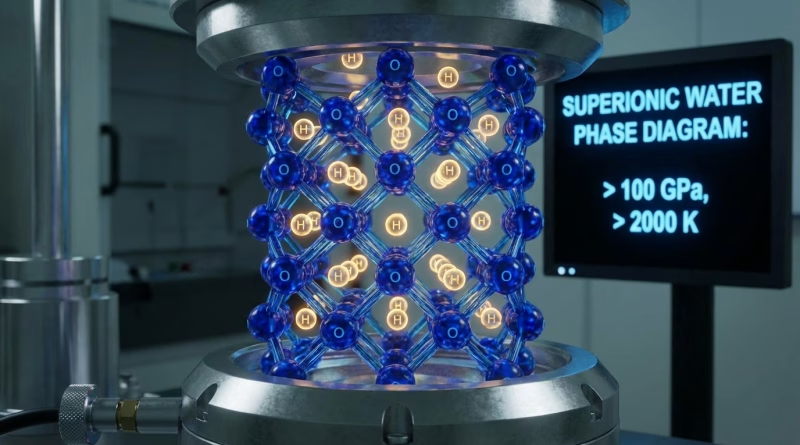
Forget everything you know about ice. Superionic water isn’t the frozen stuff in your drink; it’s a revolutionary form of matter born from unimaginable pressures and scorching temperatures found hundreds of thousands of kilometers beneath the surface of giant planets. Picture a crystalline lattice of oxygen atoms, locked rigidly in place, yet within this atomic cage, hydrogen ions (protons) are zipping around freely, almost like a liquid. This “hot, black ice” conducts electricity like a metal, yet retains a solid structure. Discovered through high-pressure experiments and theoretical simulations, this unusual water challenges our very definition of solid and liquid, existing at conditions equivalent to millions of atmospheres and thousands of degrees Celsius. It’s a phase transition that fundamentally alters planetary dynamics, marking a distinct boundary within these colossal spheres.
The Dynamo Driver How Superionic Water Generates Magnetic Fields
One of the most profound impacts of superionic water is its role in generating the bizarre magnetic fields of ice giants. Unlike Earth’s relatively simple dipole field, Uranus and Neptune boast complex, multi-polar fields that are dramatically offset from their rotational axes. This isn’t just a quirky feature; it’s a direct consequence of this exotic water phase. The free-flowing, charged hydrogen ions within the fixed oxygen lattice act as an excellent electrical conductor. As these planetary interiors churn due to convection, these moving charges create powerful electric currents. These currents, in turn, generate intense magnetic fields, much like a dynamo. The unique properties of this special water, where ions move through a solid framework, contribute to the irregular and asymmetric nature of these magnetic dynamos, a phenomenon unlike anything else in our solar system. This dynamic interplay ensures the planets remain geologically active, even without a molten iron core.
Turbocharging Heat Flow Superionic Water as a Planetary Radiator
Giant planets are still radiating heat from their formation billions of years ago, a process crucial for their long-term evolution and atmospheric stability. Superionic water plays an astonishing role in this thermal regulation. Its crystalline yet ionically conductive nature grants it exceptional thermal conductivity – far more efficient than conventional ice or even molten rock. This means heat generated deep within the core, perhaps from primordial energy or ongoing chemical processes, can be transported outwards with surprising efficiency through this unique water layer. This efficient heat transfer prevents the inner core from becoming too hot, moderating the planet’s overall temperature gradient. Without this supercharged radiator, the interiors of Uranus and Neptune might become stagnant, potentially leading to different internal structures and even altering their atmospheric dynamics. It’s a fundamental control knob on the energy budget of an entire world.
Sculpting Planetary Interiors The Architecture of Giant Worlds
The very architecture of giant planets is profoundly shaped by the existence and properties of superionic water. Beneath their thick, gaseous atmospheres, these worlds are believed to consist of distinct layers: an outer envelope of hydrogen and helium, a middle “ice” layer, and a rocky core. The “ice” layer isn’t just frozen H2O; it’s where this exotic phase reigns supreme. This exotic phase creates a stable, high-density zone that acts as a crucial boundary. It dictates how different materials mix (or don’t mix) and how convection occurs within the planet. The high viscosity and unique transport properties of this “hot ice” prevent rapid global mixing, allowing for the formation of distinct chemical and thermal gradients. Understanding these internal boundaries, formed by phases like this unusual water, is key to developing accurate models of planetary formation and evolution, especially as we gaze at exoplanets in distant star systems.
A Catalyst for Exotic Chemistry Superionic Water’s Reactive Zone
Beyond its physical properties, the realm of superionic water creates an environment ripe for extreme and exotic chemistry. The high temperatures and immense pressures within these layers mean that familiar chemical bonds can break and reform in novel ways. While the oxygen lattice remains stable, the highly mobile hydrogen ions, along with other elements like carbon and nitrogen (present in forms like methane and ammonia), can participate in unique reactions. This could lead to the formation of incredibly dense, high-pressure compounds that don’t exist anywhere else in the universe. Imagine the possibility of “diamond rain” – where carbon is squeezed out of methane and crystalizes under pressure – potentially occurring within or just below this exotic water layer. This dynamic, reactive zone isn’t just a conduit; it’s a cosmic chemical laboratory, constantly transforming the interior composition of these giant worlds and offering tantalizing clues about the building blocks of planetary systems. For more on planetary science, check out NASA’s insights: NASA Planetary Science.
What Does Superionic Water Reveal About the Cosmos Beyond?
The discovery and ongoing study of superionic water is more than just a fascinating scientific curiosity; it’s a key to unlocking the secrets of the cosmos. As we discover more exoplanets, many of them “ice giants” similar to Uranus and Neptune, understanding this bizarre form of water becomes paramount. It offers critical insights into how these distant worlds form, evolve, and sustain their environments. For future space missions, and for our 10-year horizon of space exploration, comprehending this exotic state helps us refine our search for habitable worlds, decipher the intricate dance of planetary physics, and ultimately, piece together the grand tapestry of our universe. The weirdest ice might just be the most important.