
3 Explosive Superionic Water Secrets That Shockingly Power Giant Planets
On This Page
In the vast, enigmatic reaches of our solar system, beyond the terrestrial planets and the gas giants, lie the ice giants: Uranus and Neptune. These colossal worlds, often overlooked in favor of their more flamboyant gas giant cousins, harbor an extraordinary secret at their hearts: Superionic Water. This isn’t just water; it’s a phase of H2O so extreme and mind-bendingly exotic, it redefines what we thought possible for common matter. It’s a literal game-changer in planetary science, shaping these distant worlds in ways that are nothing short of shocking.
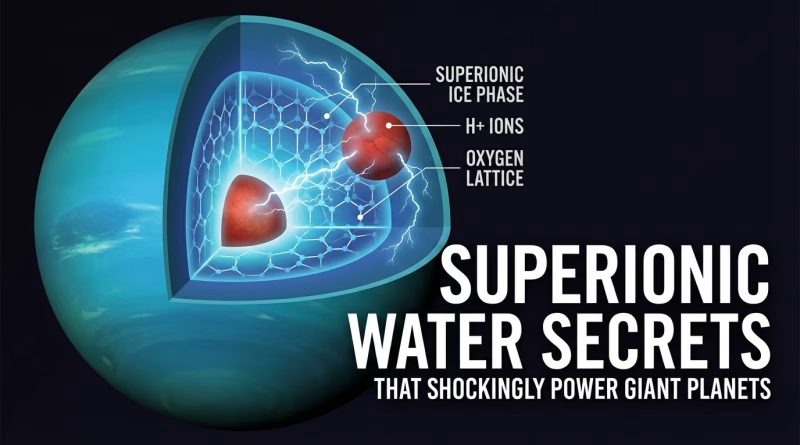
Imagine water that behaves simultaneously like a solid and a liquid. That’s Superionic Water. Under unimaginable pressures and temperatures, oxygen atoms lock into a rigid, crystalline lattice, much like ice. Yet, within this fixed framework, hydrogen ions freely flow, behaving like a liquid metal. This bizarre duality imbues it with properties that are crucial to understanding the mechanics and mysteries of ice giants. Modern computational models and advanced high-pressure diamond anvil cell experiments, pushing samples to over 2 million atmospheres of pressure and thousands of Kelvin, have confirmed its existence and critical role. Let’s dive into three explosive ways this strange solid powers giant planets.
Decoding Superionic Water: A Fourth Phase of H2O
Before we explore its planetary impact, let’s unpack what Superionic Water actually is. Most of us are familiar with water in its three common phases: solid (ice), liquid, and gas (vapor). But the universe, especially under extreme conditions, reveals far more complex states of matter. Superionic water, sometimes dubbed “black hot ice,” forms under pressures exceeding 100 GPa (gigapascals) and temperatures above 2,000 K (Kelvin) – conditions that are completely alien to Earth’s surface. To put this in perspective, 100 GPa is roughly 1 million times Earth’s atmospheric pressure, and 2,000 K is hot enough to melt most metals. Recent studies, including those utilizing advanced X-ray diffraction at facilities like the National Ignition Facility, have provided unprecedented insights into its crystalline structure and dynamic behavior.
In this phase, the oxygen atoms form a stable body-centered cubic lattice, similar to some metallic crystals. However, the hydrogen nuclei (protons) are no longer bound to specific oxygen atoms. Instead, they become mobile, diffusing rapidly through the oxygen framework. This creates a state that is electrically conductive due to the free-moving protons. It’s a solid because of the rigid oxygen lattice, but its electrical properties are those of a liquid or even a metal. This unique combination makes Superionic Water a powerful engine for planetary processes, a stark contrast to the insulating ice we’re accustomed to.
The Dynamo Effect: Powering Planetary Magnetic Fields
One of the most shocking revelations about Superionic Water is its critical role in generating the magnetic fields of ice giants. Earth’s magnetic field is powered by the convection of molten iron in its outer core, a process known as the dynamo effect. Uranus and Neptune, however, lack a significant metallic core. For decades, the source of their peculiar, non-dipolar, and highly tilted magnetic fields (Uranus’s magnetic axis is tilted 59 degrees from its rotational axis, Neptune’s is 47 degrees) remained a profound mystery. Enter Superionic Water.
The high electrical conductivity of superionic water, driven by its mobile hydrogen ions, provides precisely the medium needed for a dynamo to operate. Within the deep interiors of these planets, vast oceans of this exotic water undergo vigorous convection. The movement of these charged hydrogen ions through the planet’s interior generates powerful electrical currents, which in turn produce magnetic fields. This mechanism elegantly explains the observed magnetic anomalies. Without Superionic Water, the conventional models for generating planetary magnetic fields simply don’t hold up for Uranus and Neptune, making its existence a cornerstone of ice giant geophysics.
Driving Internal Heat and Convection Cycles
Beyond magnetic fields, Superionic Water is an explosive driver of the internal heat and convection cycles within giant planets. These celestial bodies are not static; they are dynamic systems with complex thermal gradients. The highly mobile hydrogen ions in superionic water significantly enhance its thermal conductivity, allowing heat to be transported efficiently from the extreme core temperatures (estimated to be around 7,000 K) outwards towards the cooler, less dense outer layers. This rapid heat transfer is crucial for maintaining the vigorous convection necessary for the dynamo effect we just discussed.
Furthermore, the unique properties of superionic water influence the planets’ overall thermal evolution. Simulations indicate that the specific heat capacity of superionic ice allows for more effective redistribution of internal energy, preventing localized hotspots and contributing to a more uniform, yet still turbulent, interior. This constant churning, fueled by the thermodynamic properties of Superionic Water, dictates how these planets cool over billions of years and influences their atmospheric dynamics and energy balance, impacting everything from cloud formation to atmospheric escape rates. Its presence explains why Neptune, despite being further from the sun, emits 2.6 times more energy than it receives, a puzzle that conventional ice models couldn’t fully resolve.
Shaping Planetary Structures and Composition: Superionic Water Layers
The existence of Superionic Water doesn’t just affect dynamic processes; it fundamentally shapes the very structure and composition of ice giants. Rather than a distinct core-mantle-atmosphere separation like Earth, Uranus and Neptune are thought to have a more gradual layering. Superionic water is believed to form a vast, thick layer, potentially encompassing 60-70% of the planets’ mass, acting as an intermediate “mantle” between a rocky core and the gaseous outer envelopes of hydrogen and helium.
This massive Superionic Water layer acts as a chemical and physical barrier. Its high density and unique bonding characteristics would prevent heavier elements and rockier material from migrating upwards, keeping them segregated in the deeper core. Conversely, lighter elements and compounds like methane and ammonia, which are dissolved in or coexist with the superionic phase, would be influenced by its convective movements. This stratification has profound implications for understanding the accretion and evolutionary history of these planets. For instance, the stability of this superionic layer could explain why Uranus and Neptune retained a significant proportion of water and volatiles during their formation, distinguishing them from the gas giants Jupiter and Saturn which are dominated by hydrogen and helium.
Unraveling the Enigma: How Superionic Water Holds Clues to Exoplanets
Our understanding of Superionic Water extends far beyond our solar system, offering profound insights into the rapidly expanding field of exoplanetary science. With thousands of exoplanets discovered, a significant fraction fall into categories like “super-Earths” and “mini-Neptunes”—planets that are larger than Earth but smaller than Neptune, and often rich in volatiles like water. Many of these exoplanets are speculated to host vast interiors dominated by Superionic Water due to their similar mass ranges and likely formation conditions.
By studying Superionic Water in our own solar system, we gain invaluable predictive tools for understanding the internal dynamics, magnetic fields, and even potential habitability of these distant worlds. For example, if a “super-Earth” has a superionic water layer, it might possess a strong magnetic field capable of protecting its atmosphere from stellar winds, a crucial factor for sustaining life. Researchers are actively applying the physics of superionic water to model these exoplanet interiors, enhancing our ability to interpret observational data and refine our search for life beyond Earth. It’s a bridge between the cold, distant worlds of our cosmic neighborhood and the tantalizing possibility of life elsewhere in the galaxy.