
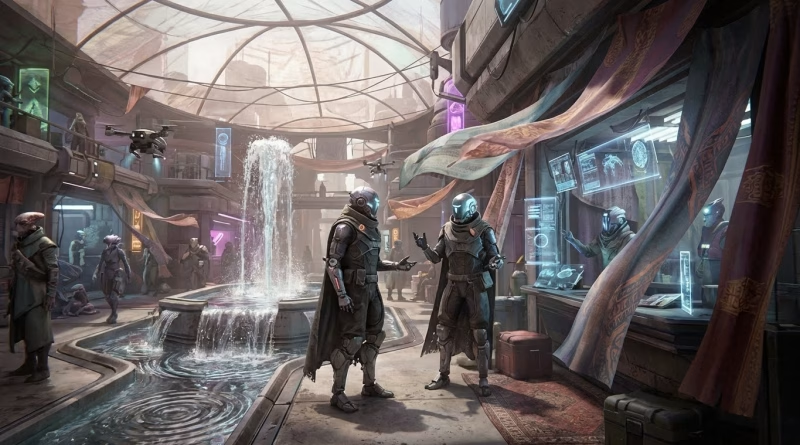
5 Incredible Ways AI-Driven NPCs are Modern Game-Changers in 2026
On This Page
The combination of AI-driven NPCs and hyper-realistic physics engines has turned gaming from a series of scripted events into a truly unpredictable experience.
For decades, the “living” worlds of video games have been a beautiful illusion. You could see a vast city, but the people in it were merely robots following a pre-written script. If you hit a wall, it didn’t break; if you talked to a guard, he said the same three lines every time. But as we step into 2026, the illusion has become a reality.
Thanks to breakthroughs showcased at CES 2026, we are seeing the “death of the script.” Here is how the technology of today is rewriting the rules of play.
1. Characters That Actually Think (The Rise of NVIDIA ACE)
The biggest shift in 2026 is the widespread adoption of AI-driven NPCs. Using technologies like NVIDIA’s updated ACE (Avatar Cloud Engine), developers are now embedding “Small Language Models” (SLMs) directly into game characters.
In new titles like inZOI and the latest PUBG updates, characters no longer wait for you to pick a dialogue option. They can hear your voice through your mic, understand your intent, and respond with unscripted, natural dialogue. More importantly, these AI-driven NPCs have long-term memory. If you steal from a shopkeeper in the first hour of a game, he won’t forget it ten hours later. He might even hire a different NPC to track you down.
2. Real-Time Physics as a Gameplay Mechanic
In 2026, physics is no longer just “eye candy.” With Unreal Engine 5.6 and the new “RTX Mega Geometry” tech, the environment is just as smart as the characters.
We’ve moved past simple ragdoll physics. Now, we have “Soft Body Dynamics” and “Real-Time Fluid Simulations” that react to your every move. If a spell hits a stone wall, the wall doesn’t just disappear; it crumbles into thousands of unique pieces based on the angle and force of the impact. If a river is dammed up by fallen debris, the water level actually rises and floods the surrounding area in real-time, changing the map for everyone.
3. The End of the “Fetch Quest”
Because AI-driven NPCs now have autonomous goals, the nature of quests has changed. Instead of a character standing still with an exclamation point over their head, you might find a character actively trying to solve their own problem.
An NPC might be trying to build a house and needs supplies. You could help them, or you could sabotage their supply line. The AI will adapt to your choice, creating a unique branching narrative that wasn’t pre-written by a human designer, but emerged naturally from the NPC’s “brain.”
4. Why 2026 is the Turning Point
What makes 2026 different from previous years? It’s the move to on-device processing. In 2024 and 2025, AI NPCs were slow because they had to “talk” to a server in the cloud, causing a delay in conversation.
Today’s 2026 hardware—like the latest RTX 50-series and AI-integrated consoles—handles the “thinking” locally. This means the interaction with AI-driven NPCs is instantaneous. The barrier between “player” and “game world” has finally been torn down.
The New Gold Standard of Immersion
We are currently witnessing a total reimagining of what it means to “play.” We are no longer just consuming a story; we are living in a world that notices us. As AI-driven NPCs become the standard, the games of the past will feel like silent films compared to the vibrant, reactive, and often shocking worlds of 2026.