
The 3 Incredible Ways AI Agent Technology Will Change Your Life in 2026
On This Page
For the last few years, we’ve lived in the era of the chatbot. We’ve grown used to asking questions and receiving text, images, or code in return. But as we enter 2026, a massive shift is occurring. We are moving from “Generative AI” to “Agentic AI.” This is the year of AI agent technology, and it marks the moment your software stops being a tool you use and starts becoming a partner that works for you.
The difference might seem subtle, but the impact is revolutionary. While a chatbot can tell you how to book a flight, an AI agent can actually find the flight, navigate the checkout page, handle the seat selection, and add the confirmation to your calendar—all while you’re asleep.

What is AI Agent Technology
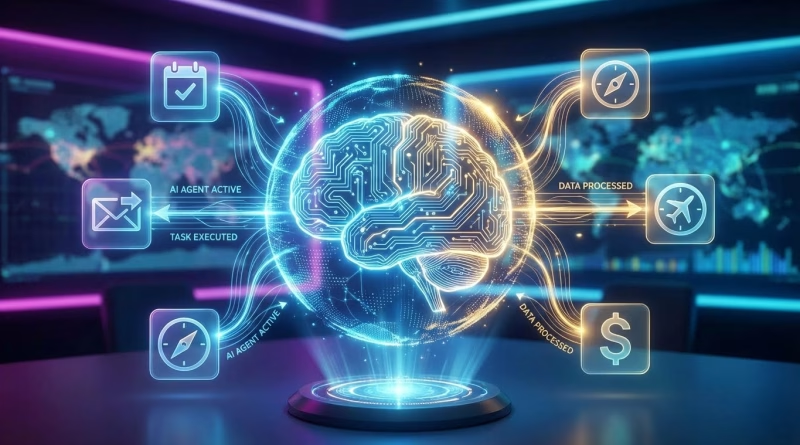
At its core, an AI agent is a system that uses a large language model (LLM) as its “brain,” but it is granted the ability to use tools and take actions in the real world.
Think of a standard AI as a very smart person locked in a room with a typewriter. They can write beautiful essays, but they can’t leave the room. An AI agent is that same smart person, but they’ve been given a set of keys, a smartphone, and a credit card. They have agency. In 2026, AI agent technology has matured to the point where these agents can interact with websites, use your favorite apps, and make decisions based on a set of goals you provide.
The Three Pillars of the Agentic Shift
Why is 2026 the turning point for this tech? It comes down to three major breakthroughs:
- Reasoning and Planning: Early AI struggled with multi-step tasks. Today’s AI agent technology utilizes “chain-of-thought” reasoning. If you tell an agent to “plan a dinner party,” it knows it first needs to check your calendar, then message your friends for allergies, then find a recipe, and finally order the groceries.
- Tool Use (APIs and Browsing): Modern agents can now “see” and interact with the same user interfaces humans use. Whether it’s clicking buttons in a browser or using an API to send a Slack message, the walls between AI and your applications have vanished.
- Long-Term Memory: One of the biggest hurdles was that AI forgot who you were the moment a conversation ended. 2026 agents have “persistent memory,” allowing them to learn your preferences over time. They remember that you prefer aisle seats and that you’re allergic to peanuts without being told twice.
How AI Agent Technology Changes Your Daily Life
We are already seeing this technology integrated into every corner of the digital world. In your professional life, an AI agent can act as a tireless researcher, monitoring industry news and drafting summarized briefs for you every morning. In your personal life, it can act as a proactive concierge, spotting a price drop on a product you’ve wanted and asking if you’d like it to complete the purchase.
The beauty of AI agent technology is that it handles the “digital friction”—the boring, repetitive clicks and data entry that eat up our time.
The Challenges Ahead
Of course, giving an AI the power to act on your behalf raises significant questions about security and ethics. How do we ensure an agent doesn’t spend money by mistake? How do we protect our private data when an agent is navigating the web for us? 2026 will be as much about defining the “guardrails” for these agents as it is about building the agents themselves.
As we look back at the history of computing, there are moments that change everything: the GUI, the Internet, the Smartphone. AI agent technology is the next leap. We are finally entering the era where software doesn’t just wait for our commands—it anticipates our needs and gets the job done.