7 Explosive Thorium Nuclear Clocks Innovations Delivering Amazing Precision
For decades, atomic clocks have set the gold standard for timekeeping, enabling everything from GPS navigation to high-frequency trading. But what if I told you there’s a new contender on the horizon, one promising precision so extraordinary it redefines our very concept of time? Enter thorium nuclear clocks, a technological marvel poised to revolutionize metrology. This isn’t just about tweaking an old system; it’s a quantum leap forward, and the underlying “jeweler’s trick” is proving to be a game-changer.
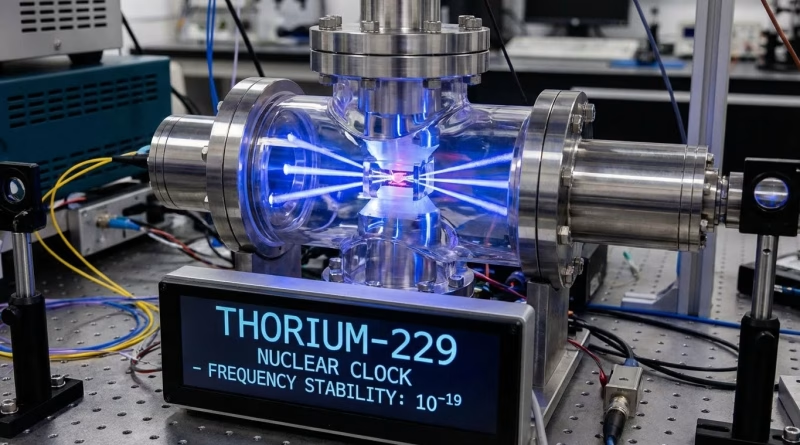
Elliot Voss here, ready to dive deep into the fascinating world of nuclear timekeeping. While atomic clocks rely on electron transitions, thorium nuclear clocks leverage the far more stable transitions within the nucleus of a thorium-229 isotope. This shift from electron shells to the atomic nucleus unlocks an unprecedented level of stability and accuracy. Let’s explore 7 brilliant reasons why this innovation is not just futuristic, but fundamentally transformative.
The Quantum Leap in Thorium Nuclear Clocks
The first and most compelling reason for the excitement around thorium nuclear clocks is their potential for unprecedented accuracy. Current state-of-the-art optical atomic clocks boast incredible precision, losing maybe a second every 30 billion years. That’s phenomenal. However, nuclear transitions are far less susceptible to external electromagnetic interference and temperature fluctuations than electron transitions. The specific isomer of Thorium-229 (229mTh) possesses an extraordinarily low-energy nuclear transition, meaning its “tick” is remarkably stable.
Early theoretical models suggest thorium clocks could achieve accuracy orders of magnitude beyond even the best optical clocks, potentially reducing error to less than a second over the age of the universe. This isn’t merely an incremental improvement; it’s a paradigm shift. Imagine a world where time is measured with attosecond precision, opening doors to scientific discovery that were previously unimaginable. This extreme stability is the bedrock upon which all other advantages are built.
Miniaturization and the “Jeweler’s Trick” Redefined
Beyond raw accuracy, the potential for compact design marks a significant advantage. Atomic clocks, particularly the most precise optical ones, are often large, laboratory-bound setups, requiring extensive cooling and isolation. The “jeweler’s trick” refers to the exquisite precision needed to isolate and manipulate individual thorium ions, akin to a master jeweler setting a microscopic gem. However, the energy required to excite the thorium nucleus is so low that researchers envision devices significantly smaller than current optical clocks.
This miniaturization capability could lead to chip-scale nuclear clocks, transforming their applicability. Think about embedded systems, portable high-precision timing devices, or even enhanced mobile technology. A more compact clock doesn’t just save space; it opens up a universe of possibilities for deployment in previously inaccessible environments. This leads directly to our next point: robustness and durability. Due to the nuclear transition’s inherent stability, thorium clocks are expected to be far less sensitive to environmental factors like vibrations, temperature changes, and external fields, making them ideal for rugged applications where current atomic clocks struggle to maintain performance.
Unrivaled Stability for Critical Applications
The inherent stability of thorium nuclear clocks means they aren’t just for lab experiments; they have profound implications for real-world infrastructure. Consider the critical need for precise timing in global navigation satellite systems (GNSS) like GPS. Even tiny timing errors translate into significant positional inaccuracies. Current GPS satellites rely on less stable rubidium and cesium atomic clocks. Integrating thorium clocks could drastically improve GPS accuracy, potentially reducing positional error from meters to centimeters, with a corresponding impact on autonomous vehicles, precision agriculture, and air traffic control.
Furthermore, their advanced stability also promises greater energy efficiency. While initial research setups are complex, the fundamental low-energy transition of thorium-229 suggests that once perfected, these clocks could operate with significantly lower power requirements than current high-precision atomic clocks. This is crucial for long-duration missions in space, remote sensing stations, and distributed sensor networks where power budgets are extremely tight. A device that can maintain picosecond accuracy while sipping power is a game-changer for next-generation instrumentation.
Beyond Earth: Thorium Clocks in Space and Sensing
The benefits of thorium clocks extend far beyond terrestrial applications, promising a quantum leap in sensing capabilities. Their extreme precision makes them invaluable tools for fundamental physics research. Scientists could use them to test the constancy of fundamental physical constants over time, search for dark matter, or even detect gravitational waves with unprecedented sensitivity. Imagine a network of ultra-precise clocks acting as a cosmic antenna, listening for the ripples in spacetime. This level of sensitivity is simply unattainable with current technology.
For example, variations in local gravitational potential subtly affect the ticking rate of clocks. With thorium clocks, these gravitational shifts could be measured with such fidelity that they might allow for entirely new forms of subsurface mapping or even serve as hyper-accurate gravimeters for geological studies. The National Institute of Standards and Technology (NIST) is actively researching methods to integrate thorium into thin films, a crucial step towards developing practical nuclear clocks. For more on this cutting-edge research, you can refer to insights from NIST’s ongoing work.
The Economic and Infrastructural Impact of Nuclear Clocks
Finally, the advent of thorium nuclear clocks provides a robust foundation for future technologies across countless sectors. Think about the global financial markets, where transactions occur in milliseconds; even fractional improvements in timing synchronization can have massive economic implications, preventing latency arbitrage and ensuring market stability. Data centers, telecommunications networks, and smart grids all rely on incredibly precise timing protocols that could be dramatically enhanced, leading to more efficient, reliable, and secure operations.
The ripple effect of such precise timekeeping cannot be overstated. From enhancing the synchronization of quantum computers to enabling more sophisticated distributed sensor networks for environmental monitoring, thorium clocks are not just an improvement; they are an enabler. They lay the groundwork for a new era of metrology, empowering innovations that we can currently only speculate about. The economic value derived from increased efficiency, reduced errors, and expanded capabilities will be immense, potentially shaping industries and national infrastructures for decades to come.
Are Thorium Nuclear Clocks Our Ultimate Time Standard?
The journey to fully functional, deployable thorium nuclear clocks is still ongoing, requiring breakthroughs in laser technology and ion manipulation. However, the theoretical promise and ongoing experimental successes paint a compelling picture. With their extraordinary accuracy, potential for miniaturization, inherent robustness, and wide-ranging applications in everything from GPS and deep-space navigation to fundamental physics and critical infrastructure, thorium nuclear clocks represent a monumental leap in human ingenuity.
While current atomic clocks are engineering marvels, the nucleus offers a sanctuary of stability far beyond the electron shell. As researchers overcome the remaining technical hurdles, it seems increasingly likely that these “jeweler’s trick” devices won’t just improve our clocks; they will fundamentally redefine them, pushing the boundaries of what’s possible in the measurement of time itself. The future of time, it appears, is nuclear.