5 Revolutionary Uterine Force Sensors Reshaping Birth
On This Page
The future of healthcare isn’t just about advanced diagnostics; it’s about intimate, real-time biological understanding. In a world accelerating towards hyper-personalized medicine, one groundbreaking innovation promises to transform humanity’s most ancient and complex processes: childbirth. We’re talking about Uterine Force Sensors. These tiny, intelligent wearables aren’t just gadgets; they’re poised to unlock labor’s mysteries, giving expectant parents and medical professionals unprecedented insights into childbirth’s science within the next decade.
Imagine a future where labor progress isn’t subjective assessment but a data-rich narrative, streamed directly from the body. This isn’t science fiction; it’s the near-future vision powered by Uterine Force Sensors. Childbirth’s journey, often fraught with uncertainty, is on the cusp of revolutionary transformation. Let’s dive into five groundbreaking insights these amazing devices are bringing to light, charting a course toward safer, smarter, and more personalized birth experiences.
The Invisible Dance Revealed by Uterine Force Sensors
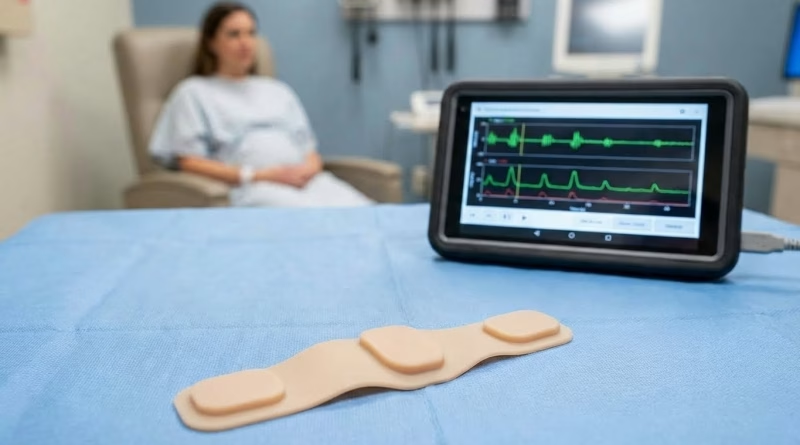
For centuries, understanding uterine contractions relied on manual palpation, subjective reporting, and external tocodynamometry – methods with limitations. External sensors are influenced by movement, offering indirect measures. Here, Uterine Force Sensors emerge as game-changers. These advanced biosensors, integrated into smart textiles or unobtrusive patches, adhere directly to the maternal abdomen, offering high-fidelity measurement of the mechanical forces at play.
Not just contraction frequency, but true intensity, duration, and propagation across the uterine wall. This granular detail has been largely invisible. Capturing this data, Uterine Force Sensors provide a real-time “map” of uterine activity, revealing subtle nuances. This isn’t just about pain management; it’s about understanding labor biomechanics previously unattainable. Doctors can differentiate effective from ineffective contractions with pinpoint accuracy, leading to informed decisions. The shift from educated guess to data-driven certainty is monumental, setting a new era in obstetrics.
Predicting the Unpredictable Early Warning Systems
One profound impact of Uterine Force Sensors will be as sophisticated early warning systems. Preterm birth, stalled labor, and uterine dystocia remain significant challenges, often leading to emergency interventions. Traditional monitoring signals issues only when acute. With continuous, high-resolution data from Uterine Force Sensors, clinicians can identify subtle deviations much earlier.
Imagine an AI-powered system, constantly analyzing unique uterine contraction patterns, learning from millions of deliveries. This system could detect nascent preterm labor risks days or weeks in advance by recognizing specific shifts in uterine micro-movements, imperceptible to humans. Similarly, if labor progresses atypically, Uterine Force Sensors could flag it long before a traditional partogram, allowing for timely, proactive adjustments. This predictive power has potential to dramatically reduce complications and improve maternal and neonatal outcomes. This isn’t just monitoring; it’s foresight, giving providers the ultimate superpower in labor management.
Personalized Birth Journeys A New Era of Intervention
Every pregnancy and labor is unique. Yet, current protocols often follow generalized guidelines, leading to suboptimal interventions. Uterine Force Sensors usher in an era of truly personalized medicine for childbirth. By providing precise, patient-specific data, these sensors enable healthcare teams to tailor interventions with unprecedented accuracy.
Is a mother progressing slowly? Uterine Force Sensors can help determine if it’s due to weak contractions needing augmentation, or if the uterus is simply taking its time, negating unnecessary interventions. Oxytocin dosage could be titrated based on real-time uterine response, minimizing risks and maximizing effectiveness. For VBAC mothers, detailed data from Uterine Force Sensors could provide critical insights into uterine integrity, empowering informed decisions and potentially increasing success rates. This granular, real-time feedback loop allows for dynamic adjustments, optimizing labor for each individual, reducing stress, and fostering empowering birth. This isn’t one-size-fits-all; it’s about crafting the perfect journey.
Beyond Human Error AI and Predictive Analytics in Action
The true magic of Uterine Force Sensors comes alive when paired with artificial intelligence. The sheer volume of data generated by these sensors would overwhelm human clinicians. This is where AI excels. Machine learning algorithms can parse through terabytes of data, identifying intricate patterns, subtle anomalies, and predictive markers missed by the human eye.
Imagine an AI assistant continuously monitoring the live feed from Uterine Force Sensors, not just flagging deviations, but suggesting evidence-based interventions or alerting the medical team to potential risks hours before they become critical. This enhances diagnostic accuracy and reduces cognitive load on healthcare professionals. The AI can learn from millions of anonymized labor records, identifying optimal contraction patterns, drug responses, and intervention timings. This systematic, unbiased analysis transcends human limitations, minimizing human error and ensuring every decision is backed by comprehensive data. The synergy between Uterine Force Sensors and AI represents a monumental leap, elevating care standards. Explore how AI is transforming medical diagnostics in general here: The Medical Futurist on AI in Diagnostics.
The Ethical Frontier What Uterine Force Sensors Mean for Consent and Privacy
As with any powerful new technology, Uterine Force Sensors bring crucial ethical considerations. The collection of highly intimate, real-time biometric data during one of life’s most vulnerable moments necessitates robust frameworks for consent, privacy, and data security. Who owns this data? How will it be stored and protected? What are the implications for patient autonomy if AI suggests an intervention based on sensor data?
These are not trivial questions. Future success and widespread adoption of Uterine Force Sensors depend on navigating these ethical waters thoughtfully. Clear consent protocols must ensure parents understand data collection, usage, and access. Strong encryption and secure data management are non-negotiable. Discussions around algorithmic bias, ensuring AI models are trained on diverse datasets to prevent disparate outcomes, are paramount. The goal is empowerment, not surveillance. By proactively addressing these ethical dimensions, we ensure this revolutionary technology serves to liberate and inform, rather than complicate, the personal experience of childbirth. The promise of Uterine Force Sensors is too great to be derailed.
What Future Births Will Look Like With Uterine Force Sensors?
Within the next decade, Uterine Force Sensors are poised to become standard tools in advanced maternal care units worldwide. We are moving towards a future where childbirth is safer, more predictable, and deeply personalized and empowering. Imagine parents feeling informed, less anxious, and more in control, armed with real-time data about their body’s incredible work. Imagine clinicians making precise, proactive decisions, guided by an intelligent system that understands the nuanced language of the uterus. This isn’t just about better medical outcomes; it’s about transforming the entire experience of bringing new life into the world, making it a more conscious, connected, and ultimately, more human journey. The age of data-driven delivery is upon us, promising nothing short of amazing.