
Why Original Intelligence (OIQ) is the #1 Career Skill of 2026
On This Page
For the last three years, the world was obsessed with “AI Adoption.” Businesses poured billions into LLMs and agents, but by the start of 2026, many realized a harsh truth: when everyone uses the same AI, everyone starts thinking the same way. This “homogenization of thought” has created a massive demand for a new kind of capability. Enter Original Intelligence (OIQ).
Launched at CES 2026 by the software company Hupside, Original Intelligence (OI) is the measurable human ability to generate ideas that break away from AI’s predictable patterns. It is the “missing link” that explains why some people thrive with AI while others simply produce “digital wallpaper.”
1. What Exactly is the OIQ Metric?
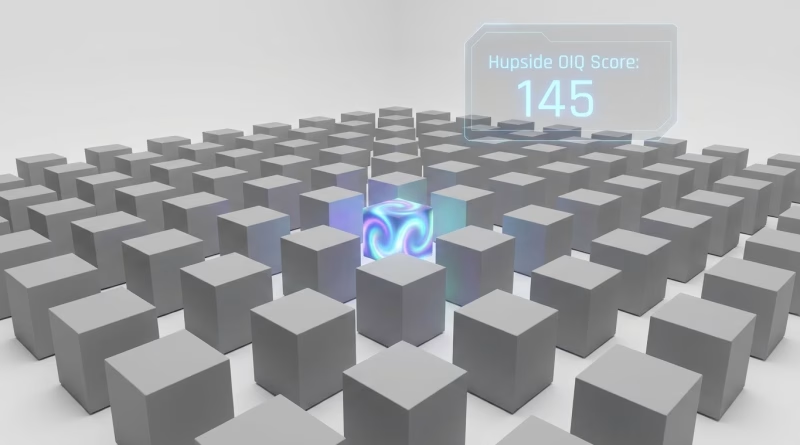
Your Original Intelligence Quotient (OIQ) is a quantifiable measure of how your thinking expands beyond the “known idea space.” While an AI like GPT-5 operates by predicting the most likely next word based on existing data, a person with high OIQ connects unexpected insights and solves problems in ways a model hasn’t been trained for.
Hupside’s patent-pending Hupchecker tool—debuted this week in Las Vegas—allows individuals to take a 5-minute interactive challenge. It compares your responses to both massive AI datasets and other humans, giving you a score that reflects your “Originality Advantage.”
2. Why OIQ is the Key to AI ROI
In 2025, companies were frustrated that AI wasn’t delivering the expected return on investment (ROI). Hupside CEO Jonathan Aberman argues this is because they focused on the technology rather than the humans directing it.
To get value from AI, you need Original Intelligence to guide it. A prompt is only as good as the original spark behind it. Without OIQ, AI just amplifies the “average.” With OIQ, humans use AI as a high-speed engine to drive entirely new concepts to market. In 2026, businesses are no longer hiring based on “AI Literacy”; they are hiring for high OIQ scores.
3. The 4 Archetypes of Originality
The OIQ framework identifies four primary “Originality Archetypes” that help organizations build balanced, high-innovation teams:
- The Divergent: Great at expanding the idea space and finding wild, new directions.
- The Connector: Sees the “invisible threads” between two unrelated industries.
- The Refiner: Takes an original spark and uses AI to polish it into a diamond.
- The Disruptor: Challenges the “AI-generated norm” to find the hidden risk or opportunity.
4. How to Cultivate Your Original Intelligence
The good news is that OIQ isn’t just a fixed number like IQ; it’s a muscle that can be trained. To stay valuable in 2026, you must intentionally move away from “Algorithm-Friendly” living.
- Seek Friction: AI loves paths of least resistance. To boost your OIQ, engage with difficult books, analog hobbies, and complex debates that don’t have a “predicted” answer.
- Prompt with Purpose: Don’t ask the AI to “give me an idea.” Give the AI your original, messy idea and ask it to stress-test it.
- Measure Your SAM: Use tools like the Hupchecker to understand your “Sameness” levels. If your work is starting to blend in, it’s time to pivot.
The Verdict: Humanity is the New Premium
As we look toward the rest of 2026, the trend is clear: AI-made work is becoming a commodity, and human-originated work is becoming a luxury. Original Intelligence (OIQ) is the shield against the “Dead Web” of synthetic content that threatens to drown out genuine human expression. It is the one thing the models can’t copy, because by definition, once a model learns it, it’s no longer original. This shift signifies a new economic era where the “human touch”—the ability to inject authentic emotion, counter-intuitive logic, and lived experience into a project—commands a massive premium.
As algorithms continue to recycle existing data into an endless loop of “average” output, your OIQ becomes your most valuable professional asset, ensuring that your voice remains distinct, unpredictable, and irreplaceable in an increasingly automated world.
In 2026, being “smart” isn’t enough. You have to be original.